

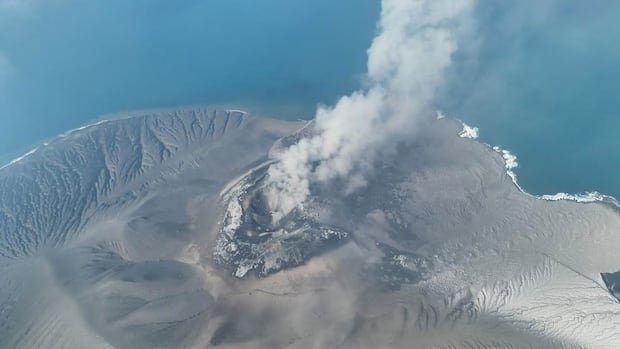

An eruption at the Anak Krakatau volcano in Indonesia early Sunday led to the suspension of all flights at Jakarta’s Soekarno-Hatta International Airport and disrupted air travel at other domestic airports as volcanic ash spread over parts of western Indonesia.
The volcanic island situated in Indonesia’s Sunda Strait, between the Java and Sumatra islands, displayed signs of activity since Friday before erupting twice on Sunday, first for 30 seconds at 3:53 a.m. local time and then for 16 seconds about three hours later, according to Indonesia’s Geological Agency. Video footage from closed-circuit cameras captured lava flares emanating from the volcano.
No casualties were reported, and no evacuation orders were issued since the nearest settlement is more than 16 kilometers away. However, authorities cautioned residents and visitors to keep a distance of at least three kilometers from the active crater.
Volcanic ash dispersed across Jakarta and Lampung province in southern Sumatra, as confirmed by Indonesia’s Centre for Volcanology and Geological Hazard Mitigation.
Due to the volcanic ash, AirNav Indonesia closed airspace around Soekarno-Hatta and Halim Perdanakusuma airports in Jakarta, along with six other airports including Radin Inten II airport in Lampung.
By Sunday evening, the closure of eight airports affected approximately 170,000 passengers from 1,558 canceled flights, with 963 flights impacted at Jakarta’s Soekarno-Hatta airport alone. All eight airports remained shut until 8:59 a.m. on Monday.
Diego Urdiales, a Spanish tourist stranded in Indonesia, expressed inconvenience over the flight disruptions, while Indonesian passenger Michele Gouw acknowledged the situation as a natural disaster, urging acceptance and compliance with airline and airport directives.
Indonesia’s Directorate General of Civil Aviation assured that they were closely monitoring the eruption’s impact on air travel and collaborating with various aviation stakeholders. Lukman F. Laisa, director general of civil aviation at the Ministry of Transportation, emphasized safety as the top priority in operational decisions amid the volcanic activity.
The volcano remained active as identified by Indonesia’s volcanology agency and the Darwin Volcanic Ash Advisory Centre in Australia, which detected two ash clouds through satellite imagery. These ash plumes reached significant altitudes and spread over several provinces and nearby waters.
Lana Saria, head of Indonesia’s Geological Agency, highlighted the escalating activity at Anak Krakatau since July, with Sunday’s eruption being the most intense during this period. The potential for further eruptions remains uncertain, with magma and volcanic gases continuing to supply beneath the volcano.
Anak Krakatau, translating to “child of Krakatau,” emerged after the historic Krakatau eruption in 1883, which had global repercussions. The 2018 eruption of Anak Krakatau triggered a tsunami that claimed hundreds of lives in Sumatra and Java, leading to considerable changes in the island’s structure.
Researchers attributed the tsunami to volcanic activity causing an underwater landslide and significant collapse on Anak Krakatau’s southwest slope. The island’s size was substantially reduced following the catastrophic event.