

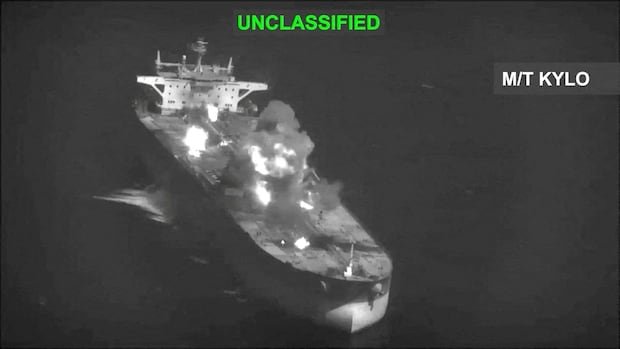

U.S. military forces attacked three Iranian oil tankers in response to ballistic missile strikes on Navy warships, as stated by American military officials on Saturday. The military warned of the potential destruction of Iran’s vulnerable oil fleet if deemed necessary. This action marked a perilous escalation following Iran’s previous assaults on commercial shipping.
The strikes occurred following U.S. President Donald Trump’s attempts to downplay the conflict as inconsequential, signaling a shift back towards hostilities after a period of intermittent warfare that commenced with U.S. and Israeli offensives on Iran in February. Both sides have engaged in military and economic retaliations, with negotiations reaching an impasse.
According to the military’s announcement, a U.S. aircraft carrier and a destroyer successfully evaded numerous unprovoked attacks by Iranian forces while patrolling the region, resulting in no injuries to U.S. personnel. The statement disclosed that two Iranian oil tankers were rendered inoperable, while a third unladen vessel was destroyed.
Iran’s state broadcaster later reported that Iran retaliated by targeting three American vessels along with three oil tankers in response to the U.S. strikes. However, this assertion could not be immediately verified. A spokesperson from Iran’s joint military command cautioned that any further interference with Iranian shipping by the U.S. could lead to intensified strikes against American military ships.
Amidst the ongoing conflict and the disabling of vessels during the U.S. blockade of Iranian ports, the total number of Iranian oil tankers targeted remains uncertain. Notably, the U.S. military previously acknowledged firing “precision munitions” at two unladen Iranian oil tankers on May 8.
The recent strikes transpired nearly a week after the resumption of hostilities between the U.S. and Iran, following a period of relative calm. The attacks primarily targeted the Strait of Hormuz and adjacent Iranian territories. Tragically, earlier in the week, at least five individuals lost their lives during a U.S. bombardment in southern Iran, including casualties at a wedding ceremony.
The conflict resurgence coincided with renewed U.S. efforts to impose economic sanctions on Tehran, as Iran’s new hard-line leadership demonstrated a steadfast stance in response to prolonged sanctions. Despite this, the elected government of Iranian President Masoud Pezeshkian has expressed a preference for a diplomatic resolution to the conflict.
As tensions persist and global oil trade routes face disruptions, the nuclear issue that precipitated the conflict, Iran’s nuclear program, remains unresolved. Diplomatic efforts to address Iran’s noncompliance with nuclear nonproliferation agreements have encountered obstacles, with the U.S., Britain, France, and Germany contemplating referring Iran to the U.N. Security Council.
Iran’s strategic leverage now centers on the vital Strait of Hormuz, vital for worldwide oil and gas shipments, which has become a focal point of contention. Despite U.S. military assistance in guiding ships through the strait, Tehran’s control over the region has impacted international maritime traffic.