

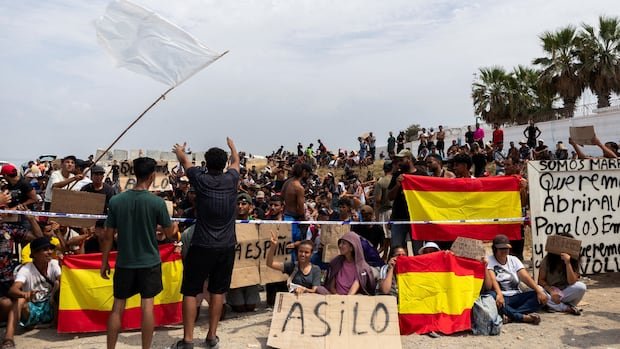

Hundreds of migrants who recently arrived in Ceuta, Spain’s North African enclave, gathered for a demonstration on a bustling urban beach last Sunday, calling on Spanish authorities to grant them asylum rather than repatriating them to Morocco. These migrants are part of the 5,000 to 8,000 individuals who remain in Ceuta following a mass border crossing two weeks ago, during which over 72,000 people flooded into the small territory, with the majority voluntarily returning soon after.
Faced with strained resources in the city, many migrants are living in challenging conditions on El Trampolin beach or on the outskirts of the city, hoping for an opportunity to continue their journey into continental Europe. Ayoub Elarroud from Tetouan, Morocco, expressed their hardships, mentioning the difficulties of sleeping by the sea in cold and unsanitary conditions, with police restricting their access to the city center.
During the protest, migrants waved Spanish flags and held banners stating their desire not to return to Morocco, emphasizing their humanity, and chanting phrases like “We’re tired” and “We need a solution.” Some migrants were seen washing clothes or fishing with makeshift bamboo rods on the rocky shores nearby.
Interior Minister Fernando Grande-Marlaska recently stated that irregularly entering migrants would not be permitted to stay in Ceuta, travel to mainland Spain, or obtain legal status, except in rare cases of extreme vulnerability. The city’s healthcare services are under immense pressure, with Ceuta’s medical board head Enrique Roviralta highlighting the exhaustion of limited healthcare workers and the increasing incidents of diseases and violence-related injuries among the migrant population.
Health Minister Monica Garcia addressed concerns about the healthcare system being overwhelmed, denying claims of a collapse but acknowledging the strain. Migrants interviewed revealed that they were driven to leave Morocco due to poor work conditions despite having higher qualifications. Many, like Mohammed Ouanzar and Emmanuel, shared their struggles and aspirations for a better life in Europe, willing to take any job available to them.
The migrants’ stories reflect a mix of challenges and hopes, with individuals like Mohammad Ismail Hossain and Ousmane recounting arduous journeys and personal struggles, seeking asylum or better opportunities in Ceuta. The situation remains complex as authorities work to address the humanitarian needs of the migrants while managing the resources available in the region.