

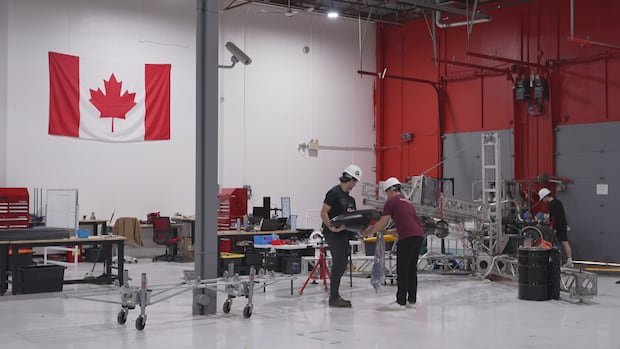

Canada, as the sole G7 nation lacking indigenous launch capabilities, is striving to develop a Canadian-made rocket. Several Canadian companies are in a race to provide the country with its own access to space, amid concerns that SpaceX may decrease the frequency of rides into orbit, affecting its customers.
The Canadian rocket companies are facing challenges in meeting stringent deadlines and adapting to evolving government priorities, complicating their journey to space. Due to Canada’s lack of rocket launch capabilities, domestic customers, including private firms and government entities, rely on external providers to deploy their satellites into orbit. The majority of these launches are handled by American companies like SpaceX.
The satellites play a crucial role in various sectors such as telecommunications, defense applications like threat detection, and earth observation like wildfire monitoring. Marc Boucher, the founder of SpaceQ, emphasized the importance of Canada controlling its own launches to prevent potential restrictions from foreign entities.
The Canadian government has identified space as a critical sovereign capability and introduced legislation to authorize launches from Canadian soil. Recent funding injections include $8.3 million each for three Canadian companies engaged in rocket development, aiming to achieve light-lift rocket capabilities by 2028.
NordSpace, established in 2022, is focused on satellite and space technology development, including building rockets and launch infrastructure. Another player, Reaction Dynamics, is working on an innovative engine design to reach orbit by 2028. The newly formed Canada Rocket Company aims to build a medium-lift rocket powered by methalox-fueled engines by 2032.
Private investments totaling $22 million have supplemented government funding for Canada Rocket Company’s endeavors. Funding has historically been a challenge in Canada, hindering rocket development efforts despite the presence of skilled engineers. With renewed financial support, there is optimism for progress in the Canadian space industry.
SpaceX’s plan to phase out its Falcon 9 rocket in favor of the larger Starship vessel raises concerns for satellite customers reliant on its services. This shift presents an opportunity for emerging rocket manufacturers to fill the void left by SpaceX. Canadian companies like Canada Rocket Company are eyeing this transition to capture market share vacated by SpaceX.
Despite the positive attention and funding influx, industry players like NordSpace’s CEO remain cautiously optimistic, recognizing the volatile nature of the sector. Long-term investments and continued financial support will be essential for achieving successful rocket launches from Canada in the foreseeable future.