

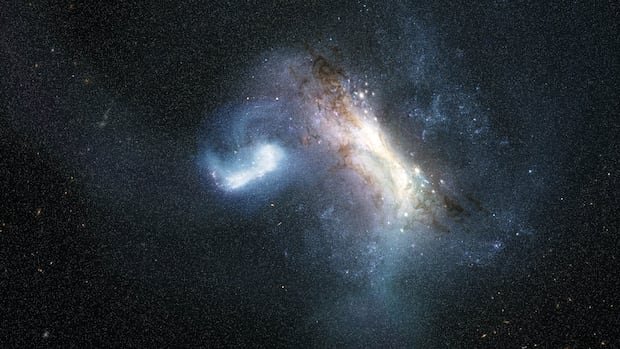

A recent study has shed light on the Milky Way’s complex journey to its current size and shape. Researchers have uncovered evidence of a significant event in the galaxy’s early history, revealing that the Milky Way absorbed a smaller galaxy approximately 11.8 billion years ago. This merger, which occurred when the universe was just 15% of its current age, represents the earliest-known galactic merger for the Milky Way.
The dwarf galaxy that merged with the Milky Way was much smaller in size, estimated to have contained stars equivalent to 500 million times the mass of the sun at that time. The study, led by astrophysicist Davide Massari, utilized data from the Hubble and Gaia telescopes to analyze stellar clusters near the Milky Way’s center, providing insights into the galaxy’s growth through mergers with smaller galaxies.
According to Massari, the merger injected a significant number of stars and interstellar gas into the Milky Way, fueling star formation and contributing to the presence of dark matter. While the merger was described as “peaceful” in terms of star interactions, the collision of gas from both galaxies likely triggered the formation of new stars.
The Milky Way has been involved in multiple mergers throughout its history, including the absorption of the Gaia-Sausage-Enceladus dwarf galaxy and ongoing interactions with the Sagittarius dwarf galaxy. Each of these events has played a role in shaping the galaxy and, ultimately, influencing the formation of celestial bodies like our solar system and Earth.
Understanding the Milky Way’s past mergers is crucial in unraveling the mysteries of our cosmic origins, providing valuable insights into the evolution of our galaxy and the broader universe.