

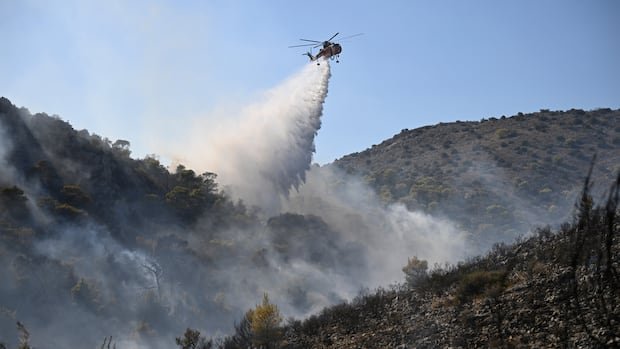

Firefighters were engaged in combatting a large wildfire that devastated a nature reserve in eastern Belgium and another on a Greek island near Athens. The fires, fueled by hot and dry conditions, caused two fatalities in Greece on Sunday.
The wildfire in eastern Belgium ravaged approximately 30 square kilometers in the High Fens (Hautes Fagnes), marking one of the most severe wildfires in recent Belgian history. Around 600 residents in the neighboring municipalities of Waimes and Bütgenbach were evacuated as the blaze spread due to shifting winds and thick smoke. Authorities urged tourists to leave the area, with a local gymnasium set up as an evacuation shelter.
Hervé Jamar, the provincial governor of Liège, reported that more than 250 emergency personnel, including Belgian and German firefighters, police, military officers, and civil protection staff, were deployed to tackle the blaze. Additionally, firefighting helicopters from Belgium’s federal police and the Netherlands were mobilized to assist in the firefighting efforts.
In Greece, the coast guard confirmed the tragic deaths of an elderly couple on the island of Salamina, located west of Athens where a fire originated. Over 500 individuals were rescued from the island. The fire erupted during the busy summer holiday weekend around the Assumption holiday, attracting many visitors from Athens. Several houses were damaged, and five people were hospitalized.
With firefighting resources stretched, approximately 192 firefighters, 14 aircraft and helicopters, volunteer teams, and municipal water tankers were deployed to contain the fires on Salamina. The coast guard and firefighting vessels were dispatched to the island, and plans were made for potential sea evacuations from threatened coastal areas. Salamina remained under a high wildfire risk warning, with the cause of the fires yet to be determined.
The ongoing wildfire in Belgium has eclipsed a 2011 fire that burned nearly 14 square kilometers in the same region, previously the largest wildfire on record in the country. Nicolas Yernaux, a spokesperson for the Public Service of Wallonia, highlighted the significantly worse conditions this time, attributing the severity to extremely dry soil.
René Dahmen, chief engineer at the Department of Nature and Forests, noted the challenging terrain hampering firefighting efforts as the fire continued to spread on Sunday. Interior Minister Bernard Quintin lauded firefighters for containing the spread of the blaze towards the west and the German town of Monschau.
European countries rallied to provide assistance as Belgium activated the EU’s civil protection mechanism. Sweden dispatched two water-bombing aircraft, and helicopters from the Netherlands and the Czech Republic were also deployed to aid in the firefighting operations.
The wildfires across Europe have been exacerbated by weeks of scorching temperatures and dry weather, posing challenges in controlling the flames, especially in areas like the High Fens with a mix of heathland and peat bogs. Belgium recently experienced another heatwave with temperatures soaring to around 37°C in some regions.
In France, firefighters managed a wildfire in the Landes region without significant flare-ups, while evacuating around 650 individuals. Meanwhile, the UK and Germany battled wildfires, with the UK warning of continued high wildfire risks due to persistent drought conditions despite the easing heatwave. Germany reported progress in containing a wildfire in the Hürtgen Forest, allowing evacuated residents to return home.