


A researcher is investigating the impact of an invasive insect and the chemicals used to combat it on the biodiversity of old hemlock forests. Hemlock woolly adelgid (HWA) has been causing significant damage to forests in southwestern Nova Scotia for nearly ten years. Various entities, including Parks Canada, the province, local groups, and private landowners, have employed insecticides like imidacloprid and dinotefuran to control the spread of HWA.
However, Mathilde Christjansen, a master’s student at Mount Allison University in Sackville, N.B., highlighted the lack of knowledge regarding the effects of woolly adelgid and the insecticides on other species. She expressed concerns about the potential impact on the nervous systems of various animals, as imidacloprid has been detected in the brains of creatures such as fish and tadpoles.
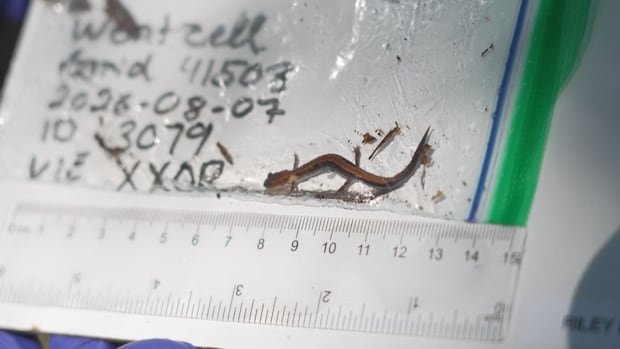
To assess the broader ecosystem impact, Christjansen’s team is focusing on the eastern red-backed salamander as a bioindicator species due to its sensitivity to environmental changes and pollutants. By studying the salamanders in treated and untreated forests, the researchers aim to gauge the overall health of the ecosystem.
The study involves placing coverboards in forests to create salamander habitats, followed by surveys to monitor populations and behavior. Behavioral tests, such as assessing reactions to predation stimuli, are conducted to gauge the salamanders’ well-being. The researchers believe that the salamanders’ condition can provide insights into the overall health of the ecosystems.
The project, led by Christjansen and supervised by experts like Julia Riley and Chris Edge, also examines the impact of dying hemlocks on salamanders. The loss of hemlocks, known for creating unique habitats with cool and moist microclimates, could detrimentally affect the salamanders’ habitat and behaviors.
The collaborative effort involves Mount Allison University, Canadian Forest Service, Acadia University, Environment and Climate Change Canada, and the University of Saskatchewan. The study is part of a larger initiative focusing on forest health in Eastern Canada.
Christjansen plans to continue her research until next year, analyzing the collected data and videos to draw conclusions. The study’s findings are expected to shed light on the intricate relationship between invasive species, chemicals, and forest biodiversity.
Image captions:
1. Image of Mathilde Christjansen, a master’s student at Mount Allison University in Sackville, N.B., leading the research project.
2. Image showing the research team consisting of Chris Edge, Julia Riley, Emily Doherty, and Mathilde Christjansen.
The research aims to understand the implications of invasive species and insecticides on forest ecosystems, emphasizing the importance of preserving biodiversity and ecosystem health in the face of environmental challenges.