

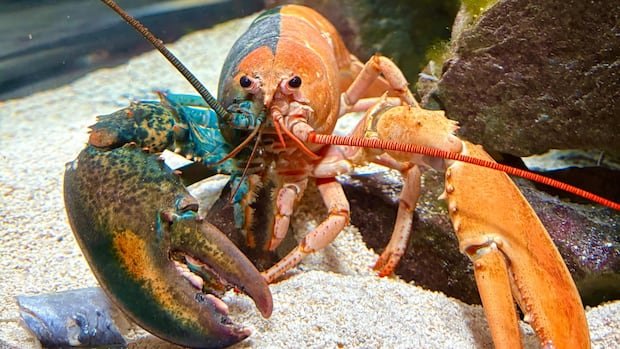

In his four decades as a lobster fisherman, Robert Wagner encountered an extraordinary sight: a lobster with one half blue and the other half orange, split right down the middle from head to tail. Wagner, amazed by the unique creature, named it Oscar and considered himself fortunate to have come across such a rare find.
Oscar was discovered in one of the final traps pulled from the waters near Blue Rocks on Nova Scotia’s South Shore. Wagner, along with his family, cared for Oscar for a month before deciding to donate him to Dalhousie University. His daughter suggested reaching out to the university, which was deemed a potentially life-saving move by Nadia Stewart, a facilitator at Dalhousie’s Beaty Centre for Marine Biodiversity.
Stewart explained that lobsters with such distinct coloring are often at risk in the wild due to predators targeting them for their standout appearance. She mentioned that Oscar’s unique coloration occurs only once in about 50 million lobsters, making him a truly rare find. Stewart also noted that albino lobsters, found in approximately one in 100 million lobsters, are even more uncommon than Oscar.
Transporting Oscar required a special license, and Wagner diligently cared for him, feeding him every other day while in a crate near his boat. Once Oscar arrived at Dalhousie University in Halifax, he acclimated to his new environment. Recently, he molted his shell, surprising the staff. The center decided to display his old blue-orange shell and give Oscar time to recover before he returns to public viewing with his new shell, which, like the previous one, will also feature the distinctive blue and orange colors.
Wagner expressed gratitude for Oscar being in good hands and hoped for the lobster to lead a happy life in his new habitat.