

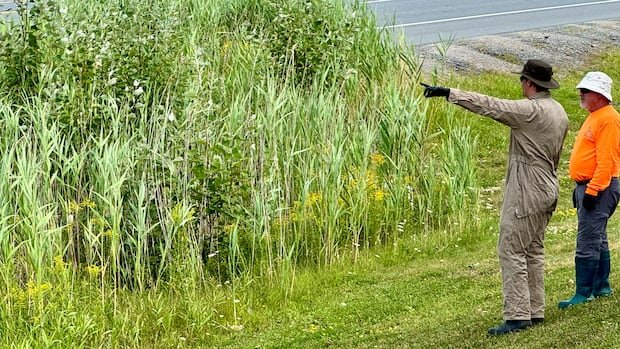

An invasive plant is expanding its reach into northern Ontario, leading local communities to collaborate on strategies for early detection and containment. The Junction Creek Stewardship Committee, based in Sudbury, organized a workshop in partnership with the Invasive Phragmites Control Centre to educate individuals on identifying and preventing the spread of invasive phragmites, also known as common reed. This plant species has the potential to form dense clusters that outcompete native vegetation and disrupt wetland habitats.
Jayden McGleish, a field supervisor at the Invasive Phragmites Control Centre, highlighted the growing presence of this invasive species in northern Ontario, including Sudbury, and the adverse impact it has on local ecosystems. The invasive phragmites can impede the movements of wildlife such as turtles and frogs, leading to fatal consequences for some. Additionally, the plant’s encroachment on recreational areas by overtaking shorelines poses a challenge for public access and enjoyment.
While southern Ontario has a more established presence of invasive phragmites, sightings have been increasing in northern regions like Sudbury, Sault Ste. Marie, Timmins, and Thunder Bay. Erik Barr from Conservation Sudbury emphasized the importance of proactive measures in addressing the spread of this invasive plant before it becomes uncontrollable in Sudbury.
To differentiate between invasive and native phragmites, it is crucial to observe key characteristics such as leaf width, stem thickness, and coloration. The invasive variety typically exhibits wider leaves, thicker stems, and a distinct thin brown line at the leaf-stem junction, contrasting with the native species’ reddish stem color and thicker connecting line.
Educating the public on distinguishing between the two phragmites varieties is vital for effective monitoring and management. The Junction Creek Stewardship Committee stresses the significance of awareness, especially along transportation routes where inadvertent spread can occur. The plant’s affinity for metal-rich soils near mining sites and waterways like Copper Cliff Creek raises concerns about its continued expansion and potential impact on local ecosystems.
In terms of treatment, Chuck Simpson from the Invasive Phragmites Control Centre highlighted the use of backpack sprayers and the herbicide Timberline as an effective method. Demonstrations on treating invasive phragmites have shown promising results, with a high kill rate achievable, although regrowth may occur in subsequent years. Vigilant monitoring and prompt intervention are essential in mitigating the invasive plant’s impact on the environment and local communities.