

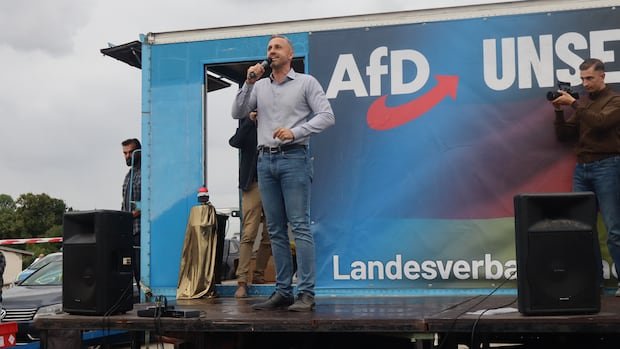

On a sunny August day in the peaceful town of Quedlinburg in eastern Germany, a large crowd gathered to listen to a prominent far-right leader discuss the future of the country. Many arrived on their Simson motorcycles, which have become a symbolic representation for the Alternative for Germany (AfD) party, to meet Ulrich Siegmund, the AfD’s candidate for leading the eastern state of Saxony-Anhalt.
The AfD is experiencing a surge in popularity in opinion polls, and in an upcoming regional election, it stands a chance to become the first far-right party to hold state power in Germany since World War II. Analysts suggest that the AfD could wield significant political influence over state resources, particularly in education. Their objectives include implementing segregated classrooms for refugees, fostering closer ties with Russia through student exchange programs, and promoting a patriotic agenda that shifts focus away from the country’s Nazi history.
“I believe [Siegmund] speaks sincerely, from our hearts,” remarked 17-year-old Luca Stemmler at the Quedlinburg gathering. “He is an inspiration to me.”
Counter-protesters across the street from the motorcycle rally displayed rainbow flags and sang The Beatles’ “All You Need Is Love” in solidarity against the AfD, which some fear may pose a threat to basic human rights and alter fundamental aspects of Germany’s postwar democratic system.
The AfD’s rise to power in Saxony-Anhalt could have broader implications, both within Germany and on the international stage, according to Marcus Böick, a historian from the region. The party’s potential success is attributed to the reluctance of major political parties to collaborate with extremist groups, a strategy known as “the firewall,” aimed at safeguarding Germany’s democratic principles.
In Saxony-Anhalt, the AfD leads in opinion polls at 42%, as per a survey by German election research company Infratest-Dimap. The party also tops national opinion polls at 28% and secured the second-highest number of seats in the 2025 federal election.
Originally founded as an anti-Euro party in 2013, the AfD shifted its focus to immigration issues in 2015, following Chancellor Angela Merkel’s acceptance of a large number of refugees into Germany.
The AfD’s platform in Saxony-Anhalt includes advocating for “remigration,” a term often used in right-wing circles to refer to mass deportations of individuals with a migration background. The party also pledges to restrict immigration from non-European Union countries deemed problematic, establish deportation centers, and create segregated classrooms for refugee children.
Akinola Sanyaolu, a Nigerian immigrant residing in Magdeburg, the capital of Saxony-Anhalt, expressed experiencing racism in the city due to immigrants being blamed for political and economic challenges. He remains hopeful about his future in Germany despite facing discrimination.
The AfD’s goals are outlined in a detailed government manifesto, which includes proposals to ban Pride flags in schools, revise history curricula to portray Germany’s past more positively, and define a “healthy family” as comprising a father, mother, and children.
If the AfD assumes power in Saxony-Anhalt, it could impact state-level intelligence services and foster closer ties with Russia, sparking concerns among experts. The party’s ties to far-right movements and ethnonationalist groups have raised alarms about its potential influence on domestic and foreign policies.
Days before the motorcycle rally, hundreds of AfD supporters gathered in Querfurt, lining up to get T-shirts signed by Siegmund, a charismatic figure with a significant TikTok following. The party’s cultural policies are often associated with Hans-Thomas Tillschneider, a local AfD politician inspired by former U.S. President Donald Trump.
The AfD’s growing popularity in Germany is attributed to dissatisfaction with mainstream political parties, heightened political uncertainty, and support from external actors like U.S. Vice-President JD Vance and entrepreneur Elon Musk.
The AfD’s potential victory could impact the federal political landscape, as the party might gain a seat in the Bundesrat, influencing legislative decisions. Despite constitutional safeguards in place, an AfD win in Saxony-Anhalt would normalize the party as a legitimate political force.
In the event that the AfD secures the most votes but is denied government participation by other parties, it could exploit the situation to bolster its narrative of victimization and garner public sympathy.
The AfD’s electoral success could have far-reaching consequences, affecting not only state policies but also reshaping the political discourse in Germany and beyond.