

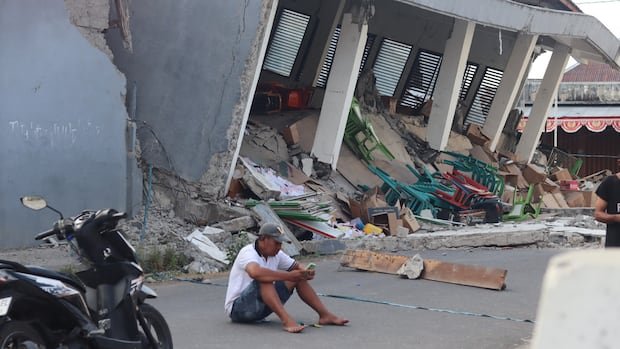

Around 5,000 individuals have been relocated following a powerful magnitude-7.7 earthquake that struck eastern Indonesia, resulting in a minimum of 53 fatalities, road blockages, and landslides, as confirmed by authorities on Sunday. Over 130 individuals have sustained injuries, many of them with fractures.
The seismic event on Saturday marked Indonesia’s deadliest incident since a prior quake in 2022 that claimed hundreds of lives in West Java. The Sikka region reported over 3,300 self-evacuated individuals or those seeking shelter in a sports venue, as reported by the disaster mitigation agency BNPB.
In Sikka, some residents found themselves stranded outdoors beside collapsed residences, sheltered under makeshift tarpaulins. Concurrently, others received medical attention in temporary facilities located outside a hospital in the port town of Maumere.
One survivor, Abdul Mutas, age 63, recounted their escape from rising tides post-earthquake, emphasizing that they fled with only their bodies. Simon Subandi, the deputy regent of Sikka, disclosed that nearly all residents in Sikka opted to stay outdoors, either on a porch or beneath a temporary shelter.
To assist the affected region, more than 3,500 military and police personnel have been dispatched, as stated by Cabinet Secretary Teddy Indra Wijaya. Concerns about aftershocks loomed, with reports of approximately 1,000 aftershocks registered post-quake.
Residents congregated in a sports stadium designated as an evacuation center, where they queued for warm beverages as the sun set. Parents improvised cradles from clothing on tent frames for their infants, while children engaged in soccer matches outdoors.
Margaretha Movaldes Da Maga Bapa, the head of the region’s disaster mitigation agency, expressed how the recent quake reignited memories of the 1992 seismic event, evoking deep-seated traumas among residents. Search and rescue efforts concentrated on clearing debris in severely impacted areas to locate potential survivors.
While power restoration efforts progressed, work on repairing distribution lines was ongoing, according to state utility firm Perusahaan Listrik Negara. An emergency declaration for the province was issued by the East Nusa Tenggara government, enabling the mobilization of resources and funding by authorities.
Geological expert Dwikorita Karnawati highlighted the seismic vulnerability of the region due to the “Flores back-arc thrust fault,” a significant network of thrust faults extending west to east. Indonesia, home to a vast population of 290 million people, lies within the “Pacific Ring of Fire,” a volatile zone where tectonic plates converge, leading to frequent seismic activities and volcanic eruptions.