

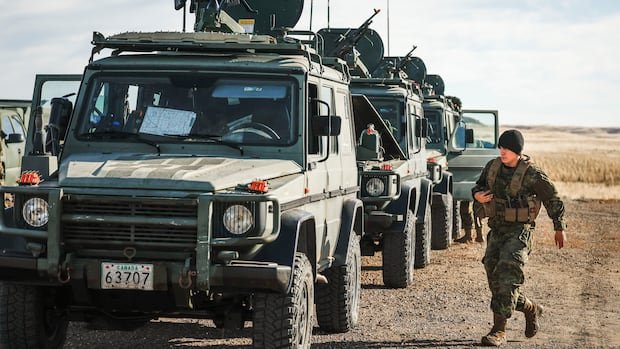

The Canadian government has quietly scrapped the second phase of a longstanding competition aimed at supplying the army with light utility vehicles. Instead, they plan to directly invite a limited number of Canadian suppliers to participate in the bidding process, according to information obtained by CBC News.
Public Services and Procurement Canada (PSPC) issued a notice announcing the government’s intention to shift to a revised procurement approach. The notice, which CBC News has acquired, cancels the invitation for interested companies to qualify for bidding on the Light Utility Vehicle (LUV) program, estimated to be valued at up to $4.9 billion as per the Department of National Defence website.
The decision to exclude foreign bidders comes after the identification of six main competitors, including U.S. companies AM General and Oshkosh Defence, and Canadian companies Armatec Survivability Group, GM Defense Canada, Roshel, and Terradyne Armoured Vehicles. The government now aims to further narrow down the field.
Following the NATO summit in Turkey, the Prime Minister’s Office highlighted new defense investments, including a revised procurement strategy for the LUV program. The statement indicated a plan to limit the tender immediately to two Canadian defense industry suppliers for the delivery of 1,600 to 2,100 vehicles and 400 to 500 light utility trailers for the militarized segment of the Canadian Armed Forces’ fleet. The selected Canadian companies have not been disclosed at this time.
The move to prioritize domestic LUV suppliers was announced before the NATO summit in Ankara and amidst the recent multibillion-dollar agreement to purchase 12 submarines for the navy from German shipbuilder ThyssenKrupp Marine Systems (TKMS).
The PSPC notice mentioned that refocusing the LUV program will also help strengthen Canada’s defense industrial base. Additionally, the government unveiled plans to allocate $800 million for a contract with Norwegian company Kongsberg Defence and Aerospace to procure joint strike missiles (JSM), advanced anti-ship and land-attack missiles designed for F-35 stealth fighters. Furthermore, an agreement was reached on the Defence Department’s Enhanced Satellite Communications Project – Polar (ESCP-P) to leverage the Telesat Lightspeed system for continuous military satellite communications in the Arctic, valued at up to $5 billion, according to department estimates.