

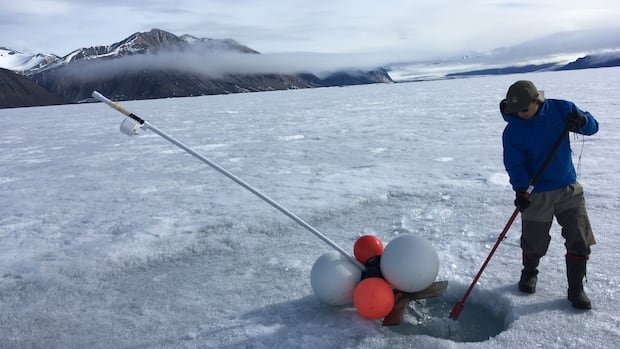

Canada’s sole remaining epishelf lake, characterized by freshwater floating on saltwater, has vanished, along with its distinctive ecosystem, according to a recent scientific study. Jérémie Bonneau, the study’s principal author and an assistant professor at Laval University in Quebec City, expressed regret over the loss, emphasizing that the Milne Fiord epishelf lake on Ellesmere Island in Nunavut was a unique feature in Canada.
The disappearing lake, which had been previously reported, highlights the impact of a warming climate on the Arctic region. The new study, recently published in Scientific Reports, outlines the process leading to the irreversible loss, signaling the end of a 4000-year era.
Epishelf lakes, formed due to glacial ice blocking freshwater from flowing into the ocean, create a freshwater layer atop the denser saltwater. The Milne Fiord lake, hidden beneath a layer of ice, had been accumulating freshwater for millennia, with a depth of 18 meters when first measured in 1983.
The lake supported distinct ecosystems in its freshwater and saltwater layers, hosting diverse microorganisms and complex eukaryotic microbes. The collapse of the Milne Ice Shelf in 2020 led to the lake’s demise, as the freshwater drained into the sea, causing an immediate impact on the unique organisms within the lake.
While epishelf lakes have disappeared in Canada, similar formations still exist in Greenland and Antarctica, although their future survival is uncertain. The loss of such ecosystems underscores the ongoing environmental changes and the delicate balance of Earth’s natural wonders.