

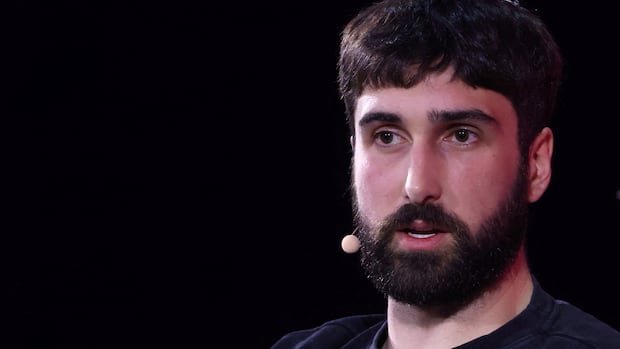

The CEO of a prominent Canadian artificial intelligence company is cautioning against “fearmongering” and is responding to recent concerns raised by an Anthropic researcher who suggested a more than 10% likelihood of AI causing harm to humanity within a decade. Aidan Gomez from Cohere in Toronto emphasizes the importance of implementing new AI safeguards while also acknowledging the potential benefits such as reducing living costs and advancing medical breakthroughs.
Gomez dismisses the notion of an extinction risk as fear-driven, attributing it to fictional narratives like those seen in movies such as “Terminator.” He criticizes the 10% extinction risk estimate as unsubstantiated and based on personal intuition rather than factual analysis, referring to a comment made by Evan Hubinger, alignment science lead at Anthropic. Despite this, Gomez aligns with Prime Minister Mark Carney’s proposal for a global non-industry entity to oversee and manage what he perceives as AI’s lesser risks.
Speaking at Carney’s investment summit in Toronto, Gomez highlights Canada’s significant role in the global AI landscape alongside the United States, China, and France due to its early contributions to AI research. He asserts that Canada should maintain control over the deployment of AI technology worldwide, emphasizing the country’s pivotal role in the technology’s development. Cohere, Gomez’s company, specializing in generative AI models for businesses, has secured partnerships with both the federal government and Bell Canada.
During the summit aimed at attracting $1 trillion in new investments to Canada over the next five years, various key announcements were made, including plans by Bell Canada to expand an AI data center near Regina. Additionally, TD Bank and Scotiabank pledged a combined $250 billion for infrastructure projects, some of which will support AI initiatives.
Carney stresses the importance of speed and predictability in advancing Canada’s investment agenda, emphasizing that efficiency and certainty provide a competitive edge. However, some leaders in the American AI sector advocate for a slowdown in developing cutting-edge AI models to address safety concerns. Gomez opposes industry-led oversight that could potentially amend antitrust rules to allow collaboration among Silicon Valley companies to shape government regulations.
Gomez favors Carney’s approach of establishing a global “technology stability” body to ensure the safe deployment of AI technology worldwide. He emphasizes the necessity of balancing safety measures with the benefits AI offers, such as enhancing efficiency and advancing medical research. Evan Solomon, the federal minister for AI and digital innovation, underscores the government’s commitment to AI safety and hints at a forthcoming significant announcement regarding AI safety in collaboration with Canadian AI pioneer Yoshua Bengio and Germany.
Jas Jaaj from Deloitte Canada believes that establishing effective international safeguards for AI will be challenging but achievable, drawing parallels to past global cooperation on major scientific breakthroughs. The competitive landscape between the U.S. and China in AI development is likened to the historical space race, with experts emphasizing the need for international collaboration to address AI risks effectively.
Amidst calls for AI regulation and safety measures, Canada is urged to safeguard its sovereignty in foreign-owned projects to protect national security interests. The importance of data sovereignty in attracting international investments for data centers is highlighted, emphasizing the need to ensure strategic capacities are safeguarded while promoting foreign investment.