

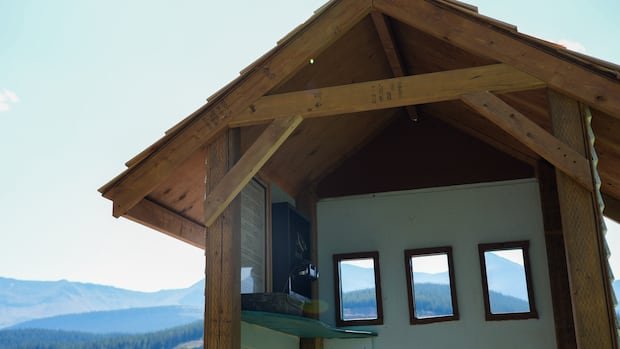

In the sunny weather at the end of July, Andy McCracken, a septuagenarian, takes a moment before dialing his late father’s number on an antique rotary telephone. The disconnected landline, housed in a small wooden structure near a graveyard in Alberta’s Rocky Mountain foothills, is known as a “wind phone.” This unique phone allows visitors to have one-way conversations with deceased loved ones.
Positioned at Mountain Park Cemetery in Yellowhead County, the highest elevation cemetery in Canada, the wind phone offers a serene spot overlooking the valley of a former coal mining community turned ghost town. Recently installed by Yellowhead County, this wind phone stands at nearly 1,900 meters above sea level, making it the highest elevation wind phone in North America.
Andy and Anne McCracken, residents of Edson, Alta., have preselected their burial plot at Mountain Park. Eligible for a plot due to Andy’s ties to a Coal Branch town, where his father worked as the mine doctor, the couple plans to have their ashes interred at this picturesque location.
Reflecting on his roots, Andy McCracken expresses gratitude to his father through the wind phone, reminiscing about his birth in Luscar, Alta., in 1953 and their shared love for the mountains.
Established in 1911 as the terminus of the Grand Trunk Pacific Railway line, Mountain Park thrived until the coal mine shuttered in 1950. At its peak, the town housed around 1,000 residents in 100 homes. Today, only the cemetery remains, with 269 documented burials starting from 1913.
During an interview at the cemetery, Madison Sharman, the heritage co-ordinator for Yellowhead County, highlights the town’s history, including its reliance on the railway for connection to the outside world. She describes the community’s resilience and resourcefulness, with residents finding ways to entertain themselves, such as organizing foot races and attending dances in nearby hamlets.
Despite the idyllic setting, Mountain Park Cemetery bears witness to the hardships faced by its early inhabitants. Infant burial sites and tragic stories from the Spanish flu pandemic and mining accidents underscore the challenges of frontier life. Pat Rausch, a long-time visitor to the cemetery, reflects on the difficulties of the past, particularly noting the infant burials and tragic deaths caused by the pandemic and mining accidents.
Restoration efforts led by volunteers, including former resident Mary Salzsauler, have preserved the cemetery’s legacy. The McCrackens, among those involved in the restoration, find solace in choosing a plot with a view of Cheviot Mountain for their future resting place.
Visiting their chosen plot, the McCrackens view the experience as a celebration of life rather than a somber occasion. Anne McCracken expresses contentment at the thought of resting in such a beautiful location, while Andy McCracken, a nature enthusiast, sees it as a fitting return to his mountainous roots.
Managed by Yellowhead County, Mountain Park Cemetery continues to honor its history while accommodating new cremation burials for individuals with ties to the area. Recent interments include notable figures like Frank and Agnes Lovsin, co-founders of Freson Bros., and John Mitchell, a D-Day veteran.
Madison Sharman envisions every cemetery in Yellowhead County featuring a wind phone, emphasizing the enduring nature of love and memories. Inside the wind phone booth, a poem penned by Sharman reflects on the connection between the living and the departed, emphasizing the timeless impact of shared stories and memories.