

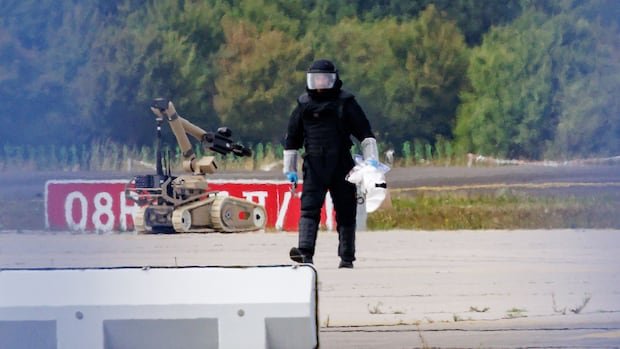

The German government has accused Russia of being behind an attempted attack at Leipzig/Halle Airport last month involving a drone carrying explosives. As a response, Germany announced the closure of a Russian consulate and other measures against Moscow. The drone, discovered near a Ukrainian plane on August 4, was safely defused, raising concerns about a heightened level of danger.
German officials, including Interior Minister Alexander Dobrindt, pointed to similarities in the drone’s components and configuration with those used in Russian hybrid operations against Ukraine. Although the attack showed signs of technical expertise and meticulous planning, it appeared to be carried out by lower-level operatives.
Authorities in Berlin indicated that individuals linked to Russian state entities were likely involved in the incident. Foreign Minister Johann Wadephul described the attack as a deliberate act by the Russian leadership to strain bilateral relations further. As a result, Germany will close the Russian consulate in Bonn and the Russian House cultural center in Berlin.
Germany plans to propose adding more Russian individuals to the EU sanctions list in response to hybrid attacks, tighten entry controls for Russian citizens, and increase scrutiny on suspected tankers transporting Russian oil in violation of sanctions. The Russian ambassador was summoned to the Foreign Ministry for discussions.
While Russia denied involvement in the drone attack, German officials remain firm in their assessment of Russian responsibility. Russian President Vladimir Putin dismissed the allegations, suggesting they were fabricated to divert attention from internal issues.
Leipzig/Halle Airport serves as a significant hub for international freight operations and support to Ukraine. Notably, the airport hosts NATO’s Strategic Airlift International Solution, which provides logistical support to NATO missions across Europe.
Western officials have attributed approximately 200 incidents of sabotage and disruptive activities in Europe to Russia since the 2022 Ukraine invasion. The EU has imposed numerous sanctions on Russia in response to these actions.
International allies, including NATO Secretary-General Mark Rutte and Canadian Prime Minister Mark Carney, expressed solidarity with Germany following the Leipzig attack. The incident has reignited concerns about Russian aggression and its impact on European security.
In a related development, Poland reported new sabotage incidents, including arson, prompting heightened vigilance against foreign intelligence activities. The country experienced a recent fire at WB Electronics, a key drone manufacturer in Europe, resulting in significant damage.