

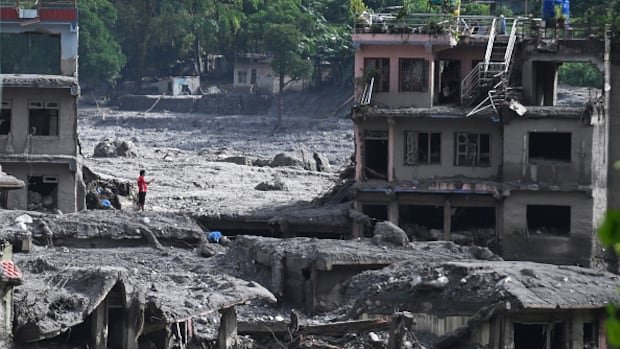

Rescue teams, accompanied by search dogs, are actively scouring the border region between Nepal and China for numerous individuals still unaccounted for after devastating floods wreaked havoc across the Himalayan region, resulting in over 1,000 fatalities. In Kathmandu, police are conducting burials for multiple bodies in designated areas, with Nepal’s disaster agency confirming 1,003 deaths and 3,916 missing persons, including 583 foreigners. Meanwhile, China has reported 16 deaths and 546 individuals missing, including 261 foreigners.
The extensive destruction caused by the disaster on August 26 is impeding rescue operations in both countries due to landslides, infrastructure damage, and challenging terrain. Efforts are underway to reach around 900 workers trapped in tunnels at hydropower projects in Nepal, with approximately 500 believed to be stuck inside. Nepal’s army spokesperson, Brig. Gen. Raja Ram Basnet, revealed that rescue teams, supported by international experts, are diligently working at various hydropower sites, navigating through debris-filled tunnels in search of survivors.
On the Chinese side, search teams are focusing their efforts on areas impacted by mudslides, particularly near Gyirong Port border crossing, which sustained severe damage. In Kathmandu, authorities are burying bodies in temporary graves, meticulously cataloging identifying details and preserving DNA samples for future identification by families. Relief operations have been expanded to reach isolated communities cut off by the destruction caused by the floods and landslides.
Nepalese authorities have rescued over 11,800 individuals thus far, utilizing helicopters and aircraft to access remote areas inaccessible by road. In response to the crisis, the Canadian government is providing $5 million in emergency aid to Nepal, with additional support earmarked for reconstruction efforts. China is also dispatching a second round of relief supplies, including drones, DNA testing kits, and water purification equipment, to assist in the ongoing rescue and recovery operations.
The catastrophic event was triggered by a glacial collapse in the Himalayas, unleashing a torrent of water, rocks, and debris downstream, resulting in widespread devastation. Prime Minister Balendra Shah emphasized the urgency of addressing climate change in the region, calling for increased awareness and action to mitigate the escalating risks posed by environmental factors.
Despite the challenges posed by the disaster, stories of hope and resilience are emerging, with individuals like filmmaker Manish Maharjan leveraging their skills to aid in rescue efforts. Drones have proven instrumental in locating stranded individuals in inaccessible locations, offering a glimmer of hope amidst the ongoing search and recovery operations.