



During a bilateral meeting in Shenzhen, China, on Tuesday, Prime Minister Mark Carney and Chinese President Xi Jinping reached an agreement to strengthen their economic and trade relationships. This agreement broadens an existing tariff deal to provide relief for approximately $400 million worth of Canadian exports, which includes certain pork and seafood items.
-
Canada and China announce new trade measures and cultural partnerships on Carney’s 1st day in Shenzhen
-
Audio
Carney floats deeper auto ties with China. What’s the risk?
In exchange, Canada has agreed to reduce certain tariffs on steel and aluminum.
Below is a summary of the implications of these changes for various industries.
Seafood
Earlier this year, Carney and Xi had already established an agreement in January that eliminated tariffs set to take effect in March 2025 on a range of farm and seafood products, including a 25 percent tariff on both lobster and crab.
On November 4, the federal government revealed that China would prolong the tariff-free treatment for an additional two years.
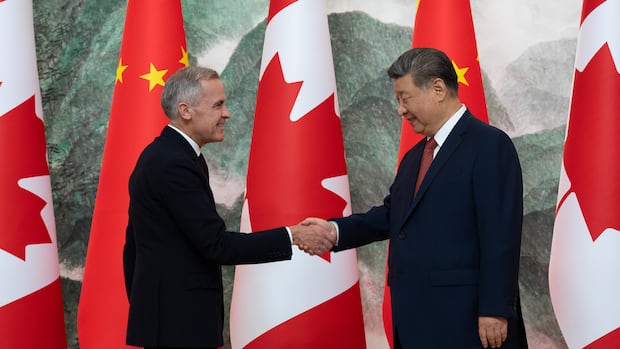
Prime Minister Mark Carney and Chinese President Xi Jinping have reached a trade agreement that will see a reduction in tariffs on approximately $400 million worth of Canadian exports, including frozen pork and shrimp, lasting until 2028. In exchange, Canada will continue to provide tariff exemptions for select Chinese steel and aluminum products.
The announcement on Tuesday broadened the tariff exemptions to encompass “specific frozen cold-water shrimp and prawns, including Pacific spot prawn ($87.5 million); certain mollusks, such as geoduck ($61.4 million); sea cucumber ($39.4 million); and Greenland halibut ($96 million).”
In 2024, approximately 16 percent of Canada’s fish and seafood exports were directed to China.
Canola meal, peas, and other crops
Similar to the relief provided in January for lobster and crab, canola meal and peas received an extension earlier this month, ceasing the previously imposed 100 percent tariffs.
The agreement on Tuesday also facilitates market entry for Canadian fava beans, chickpeas, and lentils into China.
Bill Prybylski, president of the Agricultural Producers Association of Saskatchewan, stated earlier this month that the announcement by the federal government is excellent news for canola farmers.
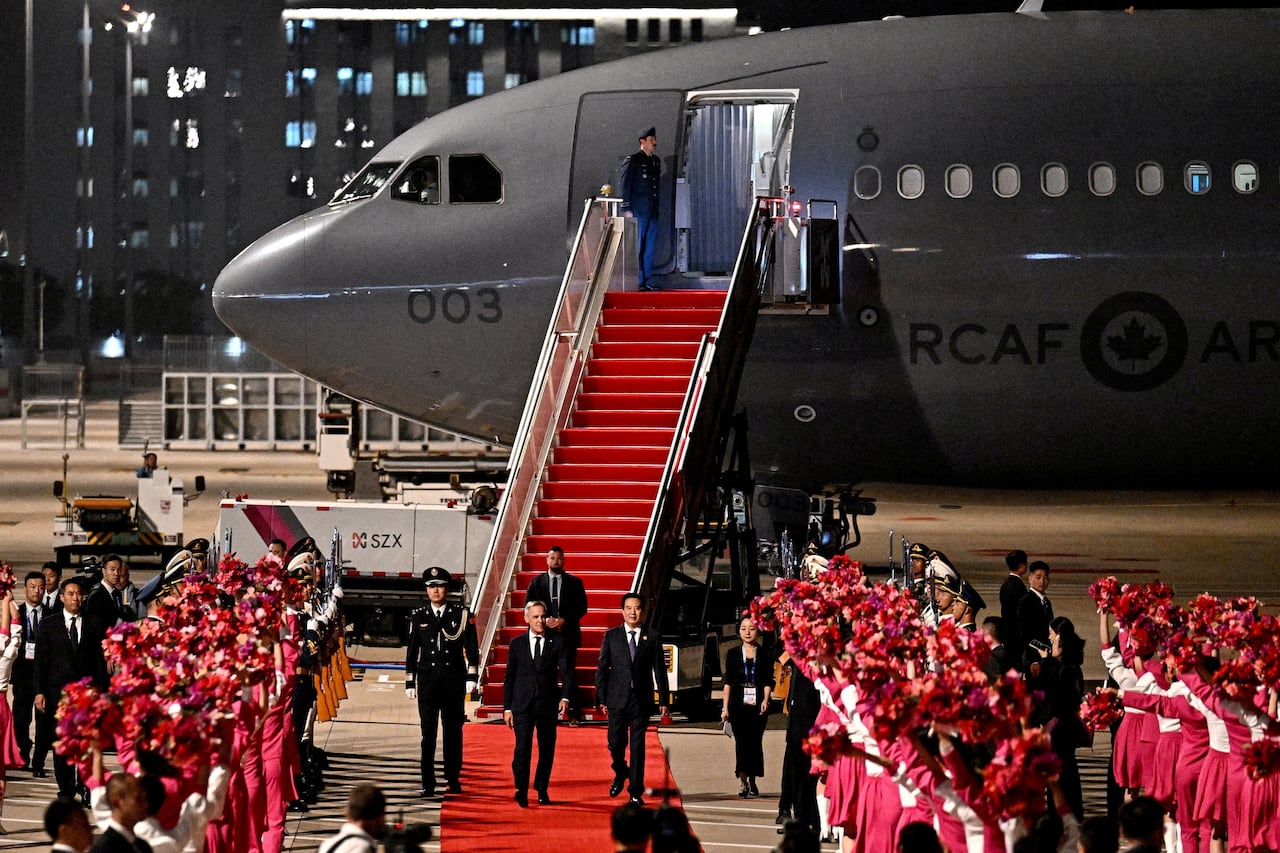
Carney arrives at the Shenzhen Bao’an International Airport ahead of the Asia-Pacific Economic Cooperation (APEC) summit in Shenzhen on Monday. (Pedro Pardo/Reuters)
“[It] provides our farmers with assurance to proceed with their plans, knowing there will be a stable market for canola meal.”
Chinese tariffs on canola seed were reduced from 84 percent to 14.9 percent in March and maintained at the lower rate with the November 4 extension.
Importantly, tariffs on canola oil are not included in either agreement and remain at 100 percent.
Prybylski expressed concern over the canola oil tariff but noted that it is less critical than the ability to market canola meal and seeds in China.
“We would prefer the tariff to be eliminated, but it is manageable for the time being,” he remarked.
Pork
Pork was not included in the January agreement, but now “most frozen pork cuts,” valued at $116 million, will have tariffs lifted until at least December 31, 2028, which is the new expiration date for all tariff agreements.
The pork industry welcomed the new agreement as a significant advancement in regaining market access that had been diminished over years of diplomatic tension.
In 2024, prior to the tariffs, Canada exported $468.6 million worth of pork products to China.
The Canadian Meat Advocacy Office, located in Beijing, praised the expanded access for pork but pointed out that offal remains restricted. Offal refers to the internal, non-muscle parts of an animal, such as organs and entrails.
Kyle Larkin, CEO of the Canadian Meat Council, emphasized that the Chinese market is lucrative, partly due to the variety of meat cuts that are consumed there.
“There is a vast consumer base in China that enjoys items like feet, heads, various offal, kidneys, hearts, etc., which are not as popular among Canadian consumers,” he commented.
Steel and aluminum
As a counterbalance to the tariff relief mentioned earlier, Canada has agreed to extend until December 31, 2028, tariff relief known as remission on specific Chinese steel and aluminum products that were set to expire at the end of this year.
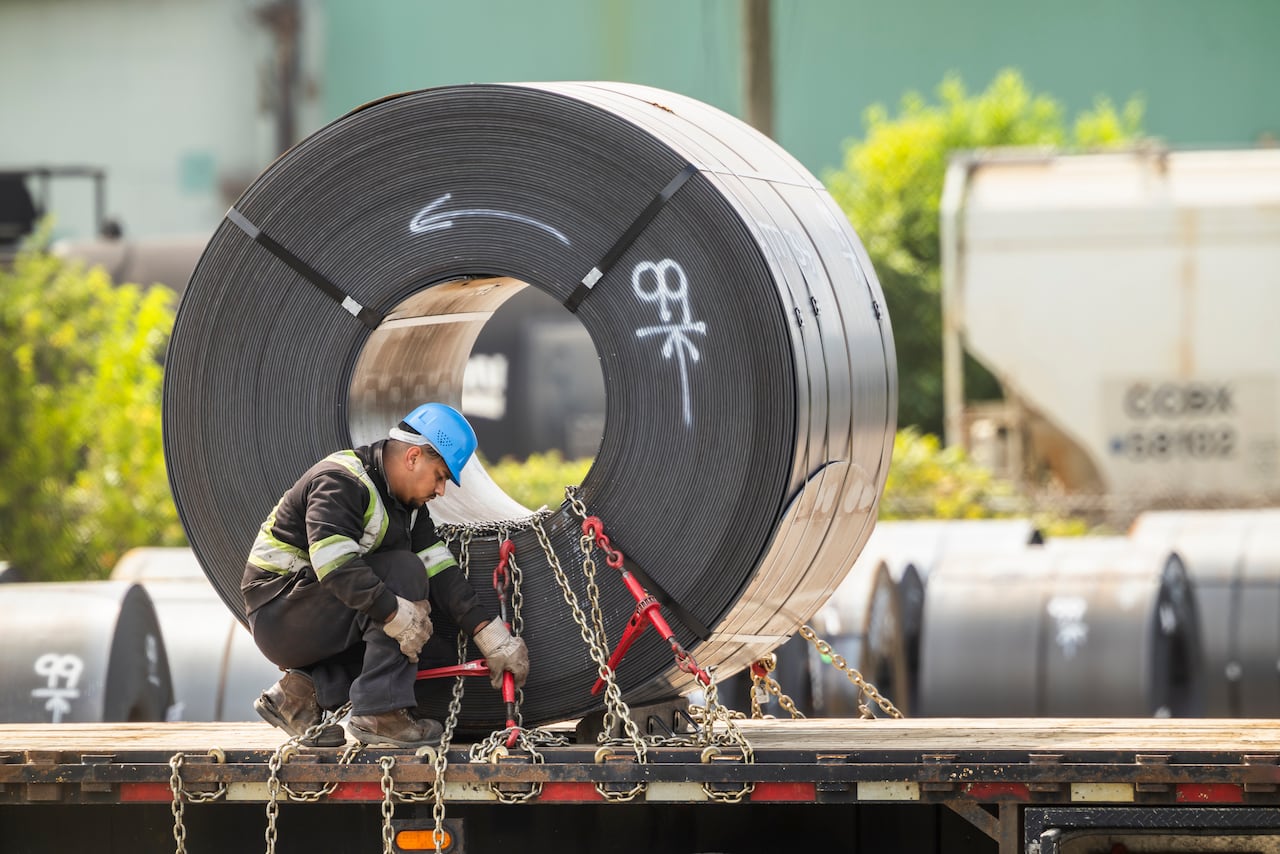
A worker secures a rolled coil of steel on a flatbed truck at the ArcelorMittal Dofasco steel plant in Hamilton, Ont., on August 20. (Nick Iwanyshyn/The Canadian Press)
The agreement on Tuesday added 32 new items to the remission list, which includes 23 steel tariff items and nine aluminum tariff items, for products that the Canadian government has classified as “insufficient or unavailable.”
CBC News has contacted the Canadian Steel Producers Association and the Aluminum Association of Canada for further comments.
Electric vehicles
In the January arrangement, Carney consented to permit tens of thousands of Chinese electric vehicles into Canada at reduced tariffs.
Canada lowered its 100 percent tariff on Chinese electric vehicles to 6.1 percent, initially allowing up to 49,000 vehicles annually, with the limit set to rise to 70,000 cars over five years. Since then, Chinese manufacturers BYD, Geely, and Chery have begun efforts to penetrate the Canadian market.
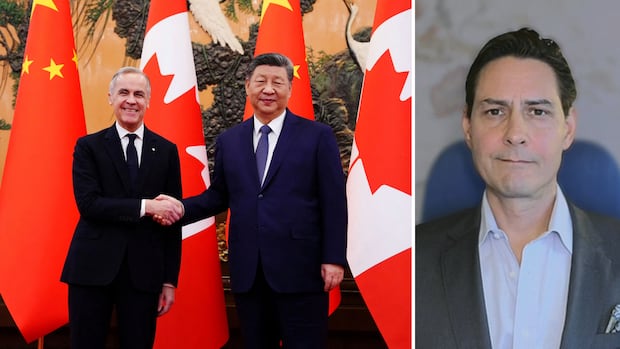
The trade relationship between Canada and China, while crucial, requires careful management, remarks Michael Kovrig, a former diplomat who endured captivity in China for over 1,000 days on espionage charges. He asserts that the advantages in Prime Minister Mark Carney’s new trade deal disproportionately favor China over Canada.
There were no significant updates concerning electric vehicles on Tuesday; however, a background document released on November 16 indicates that the deal has led to the importation of 16,211 EVs into Canada since March, with approximately half priced below $35,000 CAD.
Starting next year, the percentage of the quota allocated for affordable EVs with an import price of $35,000 CAD or less will be established at 10 percent, increasing to 50 percent by 2030.
“Canada anticipates that this arrangement will stimulate significant new joint venture investments from Chinese firms in Canada with trusted partners to safeguard and create new automotive manufacturing jobs for Canadian workers and ensure a strong development of Canada’s EV supply chain,” the document states.