

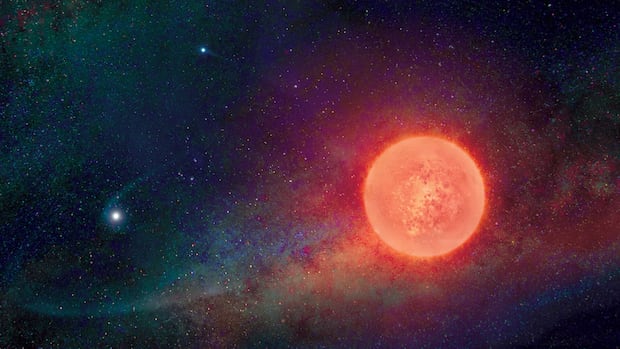

Approximately 28 light-years from our planet is an unusual star system known as IRAS 21500+5903.
Astronomers had been aware of the two stars revolving around each other for several years. However, during their search for exoplanets—planets that circle stars other than our Sun—a team of astronomers made an unexpected finding: a third star exists within this system. Rather than being a binary star system, it turns out to be a triple-star system.
“It’s quite a strange occurrence. It was a frustrating object,” remarked Étienne Artigau, a researcher at the Trottier Institute for Research on Exoplanets (IREx) at the University of Montreal. “This isn’t what we were aiming to find.”
Their research findings were published this week in the journal Astronomy & Astrophysics.
This star system consists of a red dwarf, a common type of star in our galaxy, alongside two smaller, dense white dwarfs. One of these white dwarfs is situated approximately 1,000 astronomical units (the distance from the Earth to the Sun) from the red dwarf. The other is located just two astronomical units away, comparable to the distance between the Sun and Mars.
The inner white dwarf orbits around the red dwarf, while the outer white dwarf circles both of them.
An Odd Neighbor
What is astonishing is that this third star had not been identified over many years.
“It’s peculiar that no one discovered the system, which suggests that there are extraordinary phenomena nearby that have gone unnoticed,” Artigau said. “It’s not directly next door, but just one block away in a stellar neighborhood.”
When a low- to medium-mass star reaches the end of its life cycle, it first expands into a red giant before leaving behind a small, dense white dwarf. This process is what will eventually happen to our Sun in about five billion years.
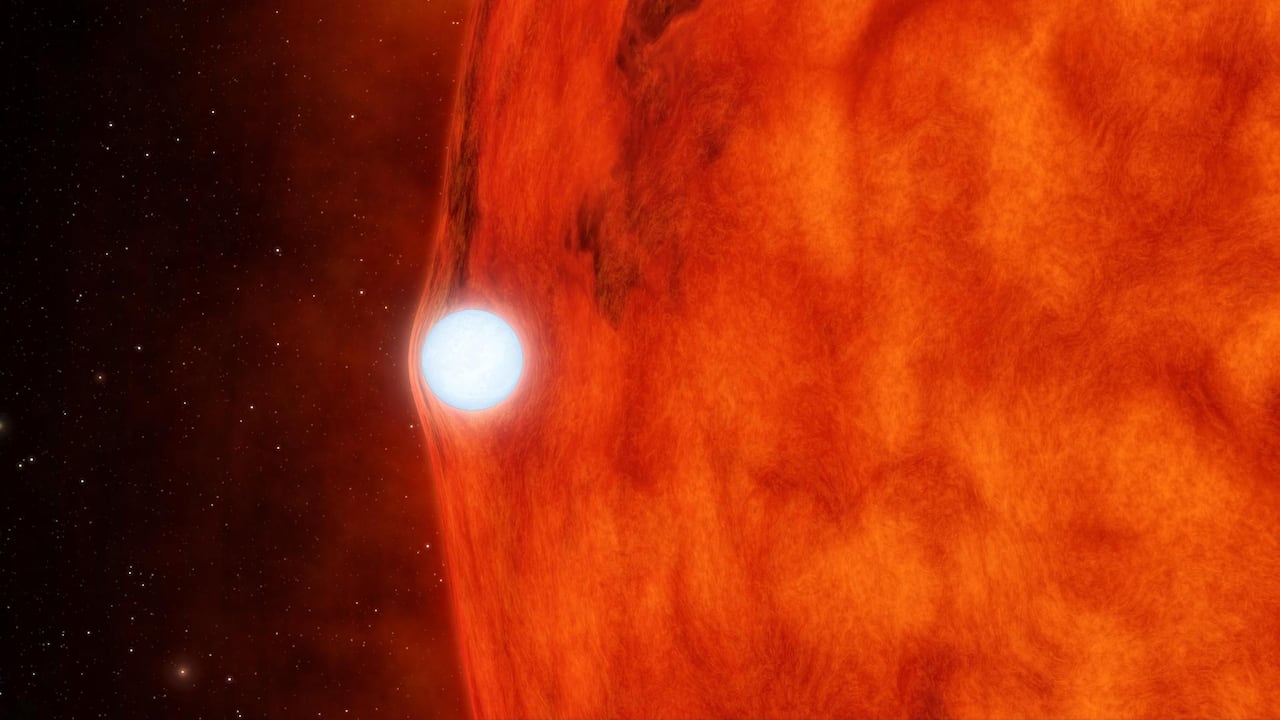
This artistic representation illustrates an ultra-dense deceased star, known as a white dwarf, moving in front of a small red star. (NASA/JPL-Caltech)
In their search for an exoplanet in this system, the international team of astronomers, spearheaded by the University of Montreal, utilized an instrument at the Canada-France-Hawaii Telescope in Maunakea, Hawaii, called SPectropolarimètre InfraROUge (SPIRou). This tool identifies exoplanets by measuring minute variations in a star’s velocity, which may be influenced by orbiting planets.
However, the red dwarf was not behaving as anticipated. It exhibited unusual movement, with velocity changes nearing 16 kilometers per second. This was a significant deviation.
Initially, they speculated it might be a brown dwarf, a type of substellar entity with a mass about 75 times that of Jupiter.
Yet, this explanation still did not add up.
Further Oddities
The discrepancies in velocity were so pronounced that they disrupted Artigau’s code.
“At one point, we concluded that something was amiss with that object. So, I corrected the code,” he explained. “Then we decided to calculate the parameters of that brown dwarf. It didn’t fit.”
It became quite a puzzling situation.
-
Are we alone? Institute searching for alien signals is using a new way to answer that age-old question
-
Astronomers think they’ve captured a planet forming around a host star — something never seen before
Ultimately, they determined that the cause of the disturbances was a high-mass… object. However, it remained invisible.
Could it be a black hole? A neutron star? A white dwarf?
The team then utilized the Gemini North telescope, also located in Maunakea. With high-resolution images acquired from its ‘Alopeke instrument—a specialized high-speed camera—they located the source of their curiosity: a dim companion star—a white dwarf—orbiting closely around the red dwarf.
Here’s where things become even more unusual.
Before transitioning into a white dwarf, this star would have swelled into a red giant. As it expanded, its orbit would have been so near to the red dwarf that the two must have influenced each other. Often, such stars engulf the red dwarf, or the two may even combine. This did not occur.
Additionally, there was more to consider.
The inner white dwarf should be spiraling inward toward the red dwarf. Instead, it maintains a stable orbit.
It’s possible that the more distant white dwarf is somehow providing stability to this orbit, although the exact mechanism remains unknown. This will require further investigation.
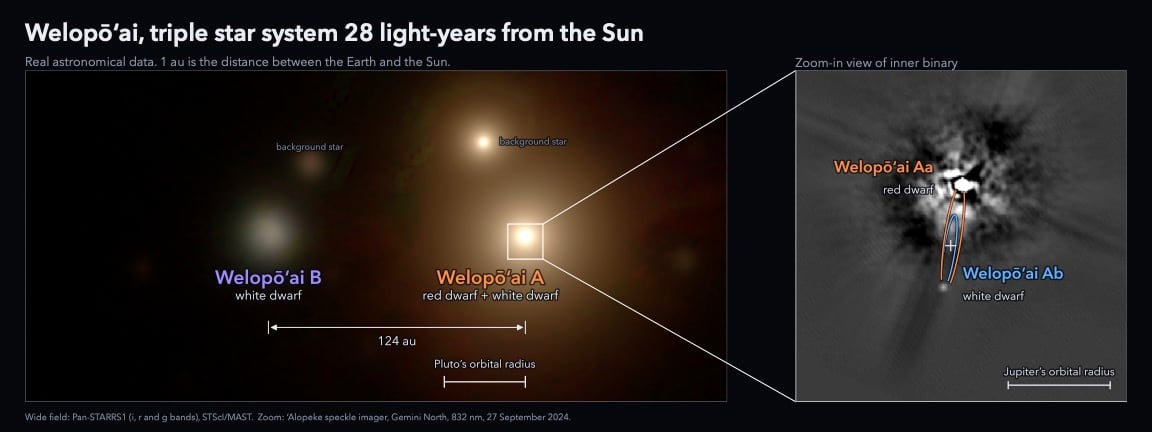
The image on the left illustrates the two components of the system: Welopō’ai A, consisting of a closely orbiting red dwarf and white dwarf pair, and Welopō’ai B, a second white dwarf situated farther away. The image on the right provides a close-up view of the inner pair and their orbital paths. (Pan-STARRS1/STScI/MAST, left, International Gemini Observatory/NSF NOIRLab, right. Graphical construction by Étienne Artigau & Heidi White (UdeM/IREx))
“We assert that it shouldn’t exist,” Artigau stated. “Yet, it undeniably exists. It’s there.”
Paul Delaney, a professor emeritus of physics and astronomy at York University in Toronto, speculated that the more distant white dwarf may have once been much closer to the other two stars.
“When planetary systems form today, migration is a standard occurrence,” he noted. “I would wager that they were relatively close together and then underwent some gravitational interactions, leading to the further white dwarf being much closer during its formative period.”
Compounding the strangeness, the researchers estimated that this system is approximately 10 billion years old, predating our own solar system, which is about 4.6 billion years old, and its stars are rich in metals. Typically, older stars are metal-poor.
“It’s intriguing, and we can’t yet ascertain if it signifies anything. It may simply be a random outcome of a stellar population,” Artigau remarked.
Continuing the Search for an Exoplanet
The astronomers assigned the Hawaiian name Welopō’ai to this system, merging “welo,” which signifies an inherited family trait, and “pō’ai,” which denotes an orbit or circular path. Thus, the name translates to “path of family traits.”
The widely acclaimed book and Netflix series 3 Body Problem explores a triple-star system and its potential impacts on a nearby planet, particularly concerning a civilization that has developed on that planet.
In the series, one of the terms employed to describe the triple-star system is “chaotic,” which influences the rate of evolution for the civilization.
This situation relates to a long-standing physics dilemma. Two-body systems are predictable; however, introducing a third body complicates everything. This is because Body A exerts a force on Body B and Body C. In turn, Body C pulls on both Body A and B, and these interactions perpetually alter their motions and forces.
While the researchers did not identify an exoplanet, Artigau emphasized that the quest is far from concluded.
“It’s such an unusual system that Atanas Stefanov, one of the co-authors, is applying for time to search for planets around the red dwarf,” he stated.
The existence of a planet in this system, or the likelihood of an alien civilization inhabiting a planet within a triple-star arrangement, remains uncertain.
For Artigau, he finds the emergence of something new in his research exhilarating.
“I enjoy it,” he expressed. “Unexpected occurrences in research add a fun twist.”