

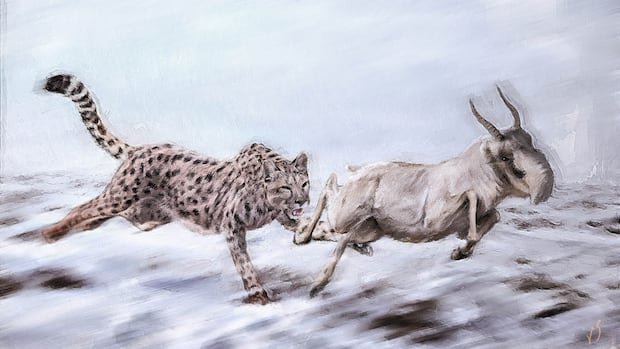

A recent discovery in the Bluefish Caves and a mine site in northern Yukon initially led researchers to believe they had uncovered remains of an ice-age puma or cougar. However, a DNA analysis conducted by the University of California revealed a surprising twist. The analysis, carried out by Molly Cassatt-Johnstone, a lab technician fresh out of her undergraduate studies, challenged the initial assumptions. The bones from Yukon, one of the first specimens Cassatt-Johnstone had worked on, did not match the characteristics of pumas.
Paleontologist Grant Zazula vividly recalls the moment he received a message informing him that the supposed cougars were, in fact, cheetahs. This revelation marked a significant advancement in genetic analysis, a process that was once considered futuristic and akin to the science fiction depicted in Jurassic Park. Cassatt-Johnstone’s discovery of the Yukon Miracinonyx, also known as the extinct American cheetah, made her the primary author of a paper recently published in Current Biology, shedding new light on the creature’s diet and habitat during the ice age.
The unexpected presence of the American cheetah in the Arctic tundra puzzled researchers, as the agile predator was traditionally believed to have evolved to hunt pronghorns on grassy plains, a prey species absent in the Beringia region. Beringia, the land connecting Asia and North America, including parts of Russia, Alaska, and the Yukon, presented a challenging environment for the survival of Miracinonyx. To unravel this mystery, a collaborative team from Canada and the U.S. employed stable isotope analysis, a technique commonly used in forensic investigations, to determine the cheetah’s diet, climate conditions, and potential migration patterns.
The findings revealed a surprising dietary preference of the Yukon cheetahs for fish, a behavior uncommon among historical and contemporary feline species. This unique ecological adaptation in a region teeming with competitors such as Beringian lions, scimitar cats, and giant short-faced bears suggests that the abundance of Yukon salmon served as a convenient and plentiful food source for the cheetahs. The study’s extensive genetic analysis further indicated that Miracinonyx had closer genetic ties to North American pumas rather than African cheetahs, with a limited gene pool likely contributing to their eventual extinction.
Paleontologist Julie Meachen highlighted the distinct behavior of the Yukon cheetahs compared to their counterparts in midcontinental North America, emphasizing their specialized reliance on salmon. This shift in dietary habits, coupled with environmental pressures and genetic constraints, offers valuable insights into the unique adaptation strategies of the Yukon cheetah population. Grant Zazula proposed renaming this distinct northern group from ‘American Cheetah’ to ‘Yukon Cheetah,’ underscoring the significance of ongoing discoveries and the continual evolution of our understanding of prehistoric ecosystems.