

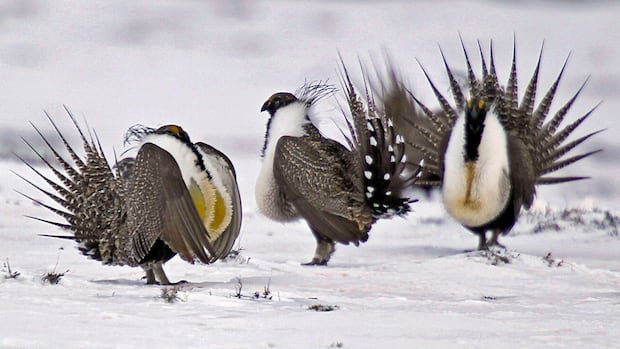

The Alberta government has eliminated habitat protections for the endangered greater sage grouse, a move that puts the remaining population at risk. The province removed these protections in designated zones through amendments to the Public Lands Act in July. This decision coincided with granting approval to Thor Resources, a helium extraction company, to operate within the sage grouse habitat.
The greater sage grouse, classified as an endangered species by both provincial and federal authorities, faces a critical situation in Alberta. With fewer than 100 birds remaining in the province, mainly confined to the southeastern region, the population has declined drastically by 98% from 1968 to 2012 due to habitat loss and industrial activities. Currently, the bird occupies only a small fraction of its historical range.
Mark Boyce, an ecology professor at the University of Alberta involved in sage grouse conservation for several decades, expressed concern over the removal of provincial protections. He warned that this decision directly endangers the survival of the already vulnerable sage grouse population in Alberta.
Joshua Killeen, from the Canadian Parks and Wilderness Society, criticized the lifting of habitat protections, stating that it undermines years of conservation efforts. He emphasized that without habitat safeguards, the chances of the species surviving are significantly diminished, possibly leading to their disappearance from Alberta and even Canada.
The provincial government defended its actions, citing the need to simplify regulations and provide flexibility for development in southeastern Alberta. Alberta’s Environment and Protected Areas communications director highlighted ongoing efforts to support sage grouse recovery through various initiatives such as habitat restoration, predator management, and monitoring.
Despite federal protections covering a portion of the sage grouse habitat, the removal of provincial regulations significantly impacts the species’ conservation. The helium industry, advocating for the removal of habitat protections, argues that balancing economic development with environmental concerns is crucial for the province’s progress.
Richard Dunn, from the Helium Developers Association of Canada, supported the decision to remove restrictive habitat protections, emphasizing the importance of balancing economic growth with environmental considerations. He highlighted the necessity of accessing certain areas year-round for economic development purposes, suggesting that the previous habitat requirements were hindering progress.