

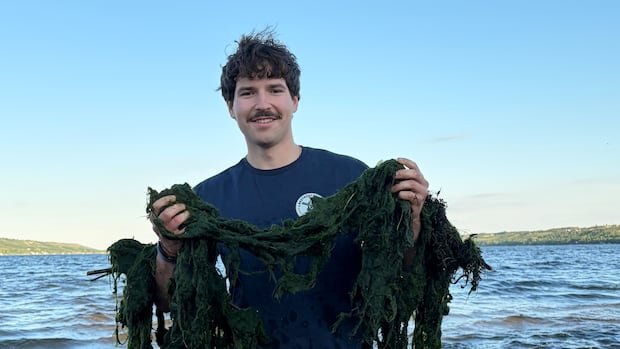

During the summer months, thick algae mats flourish in lakes across Saskatchewan, presenting an opportunity for Denhyn Holowatuk to explore its potential as a biofuel source.
Holowatuk, a recent graduate of Saskatchewan Polytechnic’s agriculture and food production program, is actively gathering algae from lakes in southern Saskatchewan to experiment with converting it into ethanol, a renewable fuel. By utilizing a fermentation process involving seaweed, sugar, and vinegar, he is able to produce alcohol that can be further processed into biofuel.
Holowatuk’s interest in algae dates back to his childhood when he would collect it from lake shorelines for his family. Over time, he expanded this activity into a small business serving other lake-goers and property owners.
Collaborating with Sask. Polytech’s Sustainability-Led Integrated Centres of Excellence (SLICE) in the Faculty of Technology and Skilled Trades, Holowatuk is investigating how algae can be fermented and distilled into ethanol. Initially, his focus was on producing organic fertilizers through fermentation but later shifted towards exploring algae as a fuel source.
Graeme Drysdale, the research chair for sustainable energy solutions at Sask. Polytech, recognized the potential of Holowatuk’s algae collection and proposed using it to produce ethanol, thereby reducing costs and creating a valuable fuel source.
Drysdale’s discussions with experts at the Hannover Messe industrial trade fair revealed past challenges in making algae biofuels economically viable. However, ongoing research and developments, such as a new jet mixer technology from the University of Utah, are making algae-based fuels more promising for commercial use.
In a separate initiative in Mexico, engineer Miguel Ángel Aké Madera is successfully turning sargassum seaweed into biofuel through his company, ‘Nopalimex,’ with plans to scale up operations to process substantial amounts of algae daily.
Holowatuk’s project aims to assess the sustainability and economic feasibility of algae-based biofuels in the long term. Currently, efforts are underway to stockpile seaweed for continued research during the winter months, with the primary challenge being the collection capacity.
Looking ahead, Holowatuk envisions accessing advanced equipment to streamline the process and hopes that his research will lead to a viable, long-term solution for utilizing algae in a beneficial way for the environment and society.