

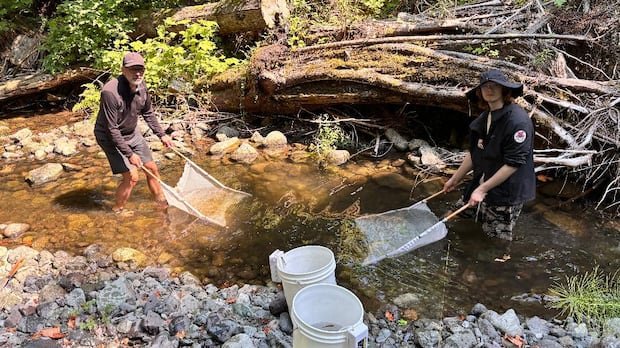

Parts of British Columbia are experiencing severe drought conditions this summer, leading to water restrictions in areas like Bessette Creek to protect salmon populations. Temporary protection orders for the Salmon River watershed have been issued and reissued due to increased wildfire risk. The Cowichan Lake Salmonid Enhancement Society is actively rescuing fish from drying rivers through fry salvage efforts. This intervention, while crucial, may not be a sustainable long-term solution according to scientists.
Bob Crandall, the treasurer of the society, emphasizes the importance of human intervention to address ecosystem challenges caused by human activities. Collaborating with the Ts’uubaa-asatx Nation and volunteers, they relocate fish to areas with more water. However, the increasing difficulty of the work due to climate change is evident as streams are drying up farther upstream than before.
Efforts involve using aerators and bubblers to ensure fish survival during transport. Crandall, with a lifelong connection to fish, stresses the significance of preserving fish within the ecosystem. The Ts’uubaa-asatx Nation plays a vital role in fry salvage efforts, utilizing drones to identify drying streams and aiding in the relocation process.
In France, similar rescue efforts are facing challenges due to severe drought and extreme heat. Jean-Pierre Faure highlights the inadequacy of current management programs in dealing with unprecedented weather events. The impact of climate change on river flows is forcing fish into small water volumes, leading to increased competition and fatalities. Faure stresses the need for ecosystem restoration and water-use management as a priority over short-term interventions like rescue fishing.