

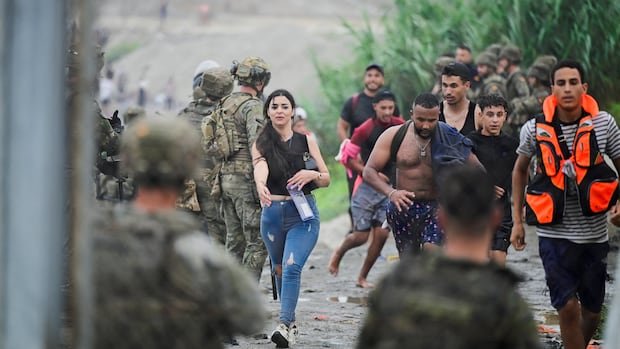

Spain and Morocco have strengthened the border fence of a Spanish enclave to curb mass crossings, which saw tens of thousands of individuals arriving by sea and land in a single day. At least 57 casualties have been reported after approximately 60,000 people entered Ceuta in recent days, according to Juan Jesus Vivas, the leader of the Spanish enclave in North Africa. By 6 p.m. local time on Friday, an estimated 48,300 migrants had voluntarily returned to Morocco, as confirmed by Spain’s Interior Ministry.
The surge of migrants into Ceuta, a small Spanish territory protruding into the Mediterranean from Morocco, has caused an uproar and division in Europe. France announced increased border checks with Spain, while Italy threatened to suspend Spain from the European Union’s internal open border scheme. Moroccan authorities at the gates of Ceuta used water cannon trucks, batons, and tear gas to push back and prevent more individuals from storming across the border, resulting in clashes and damage to property.
Despite a court ruling that placed restrictions on immediate expulsions from the enclave, Spanish authorities pledged to expel those who entered illegally promptly. Prime Minister Pedro Sanchez condemned the mass crossings as a violation of Spain’s territorial sovereignty and urged Morocco to intensify its efforts to control the outflow of people.
Ceuta and Melilla, another Spanish autonomous city in northern Morocco, have the European Union’s only land borders with Africa. These cities, each with a population of around 85,000, witness occasional surges in attempted migrant crossings. Territorial Policy Minister Angel Victor Torres suggested that a recent ruling by Spain’s Supreme Court, preventing immediate returns of migrants intercepted at sea while heading to Ceuta or Melilla, may have contributed to the surge.
Migrants often swim from the Moroccan towns of Fnideq or Belyounech to reach Ceuta, covering distances of approximately five kilometers or less. Despite reinforced security measures on the Moroccan side of the border, groups of migrants sought alternative routes along the coast. The situation prompted responses from European countries, with France announcing heightened police presence at the Spanish border, and Italy expressing readiness to take extraordinary measures, including suspending the Schengen Area with Spain.
Migration remains a contentious issue across Europe, with right-wing parties gaining prominence since the 2015 crisis when over a million people crossed the continent seeking asylum. Leaders in various countries have voiced concerns about border security and potential influxes of migrants. Amid the ongoing debate, Spain’s stance on illegal crossings remains steadfast, emphasizing the positive economic impact of immigrants and offering amnesty programs to integrate them into society.
Italy’s Foreign Minister criticized Spain’s citizenship grants to irregular immigrants, labeling it as encouraging human trafficking. In response, Spain’s Foreign Minister denounced the statement as inappropriate and called for solidarity rather than political rhetoric. The situation underscores the complex challenges and differing perspectives surrounding migration in the region.