

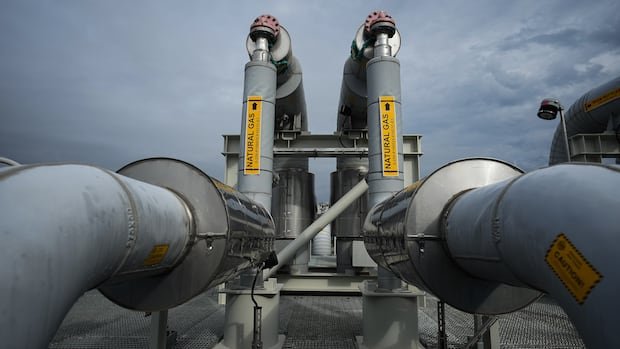

Prime Minister Mark Carney recently emphasized the significant role Canada plays in fueling American economic growth through natural gas exports to the United States. This raises the question of the potential consequences if Canada were to cease these shipments.
While energy products like oil and natural gas have not been utilized as bargaining chips in the ongoing trade tensions between Canada and the U.S., the discussion around this idea remains contentious. Alberta Premier Danielle Smith has consistently opposed the notion, whereas Ontario’s Doug Ford advocates for exploring all available options.
Carney highlighted the impact of Canada’s energy exports, stating that Canada supplies 99% of the U.S.’s natural gas imports, 85% of their electricity imports, and 60% of their crude oil imports. Despite this, U.S. natural gas imports from Canada, as reported by the U.S. Energy Information Administration, only represent a fraction of America’s total natural gas consumption.
Dulles Wang, the director of Americas gas and LNG at Wood Mackenzie, noted that while Canadian natural gas shipments to the U.S. are relatively small compared to domestic production, the regional distribution of these deliveries is crucial. For instance, the Pacific Northwest heavily relies on Canadian gas imports.
Ceasing natural gas exports to the U.S. could have severe repercussions for Canada’s energy industry, potentially leading to oversupply and plummeting prices. Wang warned that such a move could harm Canada economically by losing its primary customer and disrupting the market equilibrium.
To mitigate reliance on the U.S. market, Canada is exploring opportunities to expand its energy exports to non-U.S. markets, such as recent shipments of liquefied natural gas to Asian markets. Investments in projects like the LNG Canada facility in Kitimat, B.C., underscore the government’s commitment to diversifying energy export destinations and reducing dependency on the U.S. market.
The importance of supporting such initiatives is evident in the government’s efforts to back projects like the second phase of the LNG Canada facility and the Ksi Lisims LNG export facility. Wang emphasizes the necessity of sustained commitment to these projects to avoid continued reliance on the U.S. market.