

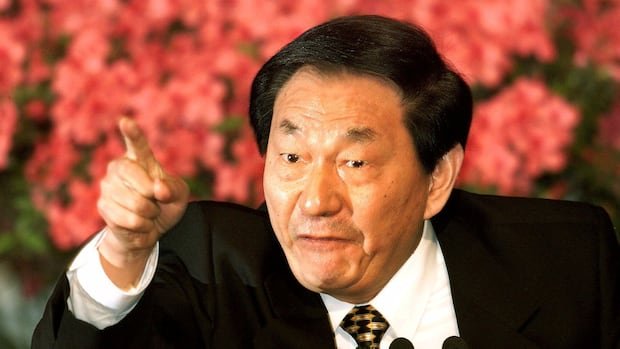

Former Chinese premier Zhu Rongji has passed away at the age of 97, as reported by state media. The announcement by the official Xinhua news agency stated that Zhu succumbed to an illness in Beijing at approximately 11 a.m. on Wednesday. Known for his impatience and sharp demeanor, Zhu played a vital role in kickstarting China’s economic surge in the 1990s by implementing significant reforms in the state industry and steering the country towards joining the World Trade Organization.
Despite facing exile in rural areas for supporting reforms in other communist nations, Zhu spearheaded a series of transformative initiatives during his tenure as premier from 1998 to 2003. His confrontations with Communist Party traditionalists and state industry leaders led to the restructuring of state-owned enterprises for enhanced efficiency and profitability, albeit resulting in substantial job cuts. These measures propelled China to surpass Japan as the world’s second-largest economy after the United States in 2010.
Expanding on the groundwork laid by former leader Deng Xiaoping’s reforms in 1979, Zhu is credited with the determination and ingenuity to drive monumental changes such as China’s accession to the WTO, contributing to China’s evolution into a dominant global exporter. These reforms sustained economic growth above eight percent annually from 2000 to 2010, peaking at 14.2 percent in 2007.
Assuming office as premier at the age of 69 in 1998, Zhu garnered widespread popularity by denouncing official incompetence and corruption while assuming responsibility for governmental shortcomings. His rigorous leadership style earned him monikers like “Boss” and “Madman Zhu,” with his resolute stance against corruption evident in his statement in 1998, “I have prepared 100 coffins here — 99 for corrupt officials and one for myself.”
Zhu, positioned as the third-ranking figure in the party hierarchy beneath President Jiang Zemin and Li Peng, made a name for himself in the 1990s as a deputy premier by curbing inflation through strict price controls and halting loans to unprofitable state enterprises despite opposition from local authorities. He spearheaded the efforts to secure China’s membership in the WTO through arduous negotiations, culminating in China’s accession in December 2001, enabling Zhu to enforce free trade policies and dismantle protectionist practices at the local level.
In 1998, Zhu catalyzed a surge in homeownership by initiating the sale of apartments owned by state entities, leading to a widespread transition to private property ownership in urban areas within a decade. Notwithstanding this, Zhu maintained his stance against privatizing the economy, advocating for the transformation of state-owned enterprises into profit-oriented entities while retaining government ownership.
Born on October 23, 1928, in Hunan province, Zhu endured a lengthy political exile after being labeled a “rightist” in 1957 for endorsing reforms in Hungary and Yugoslavia. Rehabilitated in 1979, Zhu’s rapid ascent saw him assume key roles in Shanghai’s local government before his national prominence as premier and a member of the party’s ruling Standing Committee.
Throughout his tenure, Zhu displayed a rare willingness to acknowledge and rectify official failings, publicly assuming responsibility for government lapses, such as during the 1998 summer floods and a tragic school explosion in 2001. Renowned for his humor and self-deprecation, Zhu injected levity into the party’s image, even joking about his appearances in public.
One of Zhu’s significant achievements as deputy premier was the overhaul of the tax system, compelling local officials to remit more revenue to the central government. His contributions to economic policy led him to jest in 1996 about deserving a Nobel Prize in economics for his efforts.