

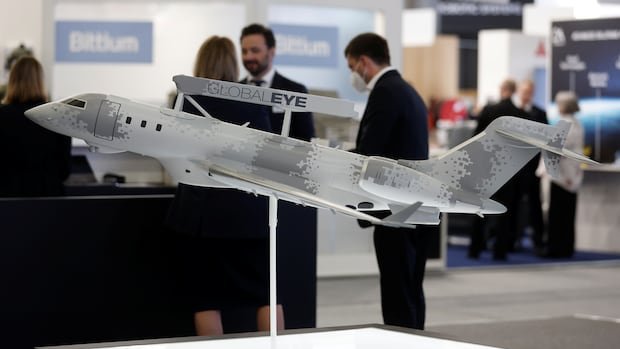

Ottawa initiated talks to procure six of Saab’s GlobalEye surveillance planes without assurance that they would fully align with military needs, as per sources. Recent evaluations indicated the aircraft only partially met requirements, necessitating modifications for operational readiness.
Prime Minister Mark Carney’s unexpected announcement at Ottawa’s CANSEC event in May included plans for the acquisition, with provisions for a local production line. The decision caught many off guard, including the Royal Canadian Air Force commander present at the event.
The contractors involved remained undisclosed to maintain their relationship with the government, with four sources providing confidential insights. At the time of the announcement, potential bidders were unaware of the exact technical and operational specifications for the airborne surveillance fleet.
Stephen Fuhr, responsible for military procurement, emphasized the importance of considering factors like cost, job creation, and geopolitics alongside requirements. The Defence Investment Agency, under Fuhr’s leadership, disputed claims of uncertainty regarding GlobalEye’s suitability, citing awareness of the aircraft’s capabilities and alignment with military needs.
Despite lacking visibility into military requirements, Saab’s GlobalEye was chosen due to its proven track record and minimal developmental risks. The rushed decision prompted the Royal Canadian Air Force to address mismatches between the aircraft’s capabilities and operational needs, especially in Arctic surveillance.
Saab executives affirmed readiness to meet Canadian military expectations, highlighting the ability to customize radar systems and incorporate air-to-air refueling features. Concerns persisted over the aircraft’s radar coverage, crew stations, connectivity, and refueling capabilities, necessitating modifications for improved functionality.
The procurement process’s deviation from standard practices raised concerns among defense experts, emphasizing the need for a balanced approach between industrial policy and defense requirements. The tension between job creation priorities and military needs underscored the necessity of a strategic defense policy to guide procurement decisions effectively.