

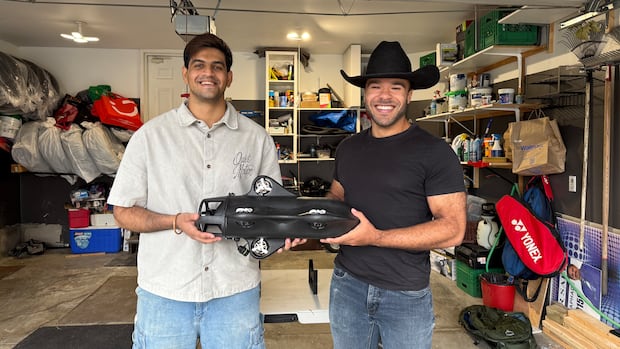

Last December, Samuel Scrivens was in his bedroom when he conceived the idea of creating an autonomous underwater drone.
Scrivens shared with CBC News, “I envisioned a concept that could transform the way we utilize autonomous underwater vehicles.”
He contacted his friend and former Carleton University classmate, Shrey Naphade, to discuss his vision of a portable drone that could easily fit into a backpack for transport.
The objective was to develop a versatile drone suitable for underwater inspections, defense, or surveillance operations.
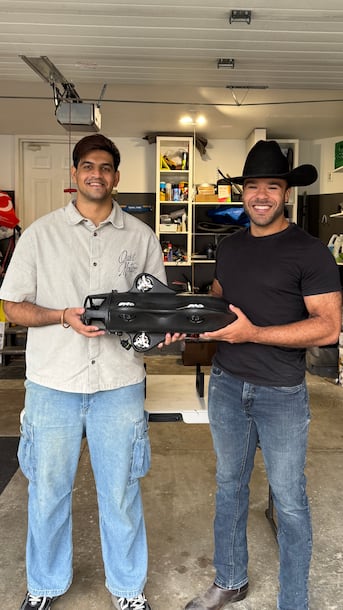
Shrey Naphade and Samuel Scrivens from Waterloo created an underwater drone after recognizing the demand for compact, portable options in the industry. They established a company named Pelagos and 3D printed a prototype of their small, portable drone known as Vantage, which has already attracted its first customer.
Naphade recalled, “It all began with a call on Discord. One call led to two, then three, and before we knew it, we had a written plan. What should we do next?”
The two engineers set out to gather enough funds to construct a prototype. Scrivens relocated to Naphade’s parents’ home, where they spent five months working in the garage, often until the early hours of the morning.
Their initial sketch of the drone was made on a napkin, which later transformed into a 3D-printed model featuring propellers crafted from materials sourced at a hardware store.
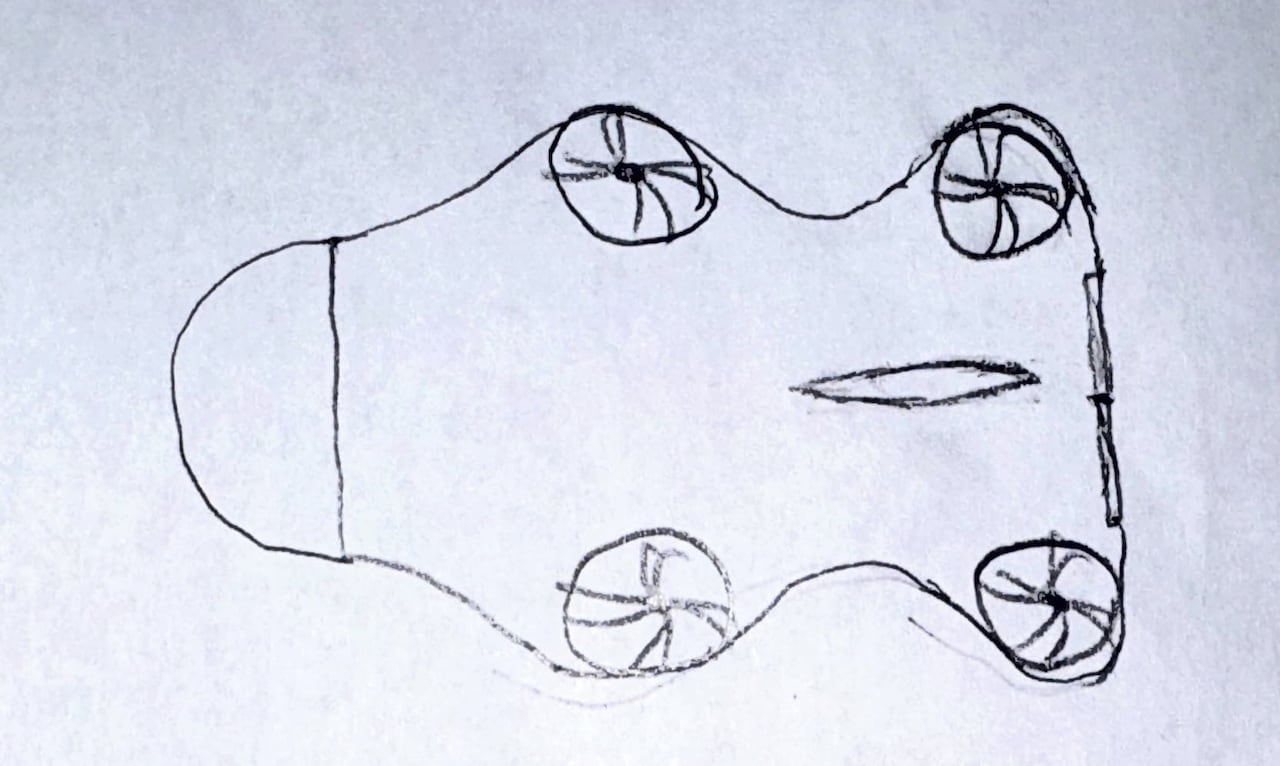
The initial concept of Vantage, Pelagos’ underwater drone prototype, sketched on a napkin. (Submitted by Pelagos)
After assembling their prototype, named Vantage, the duo proceeded to conduct leak tests in their neighbor’s pool.
This September, they secured their first customer.
Drone can be carried like a surfboard
TEKMARA, a US-based firm that specializes in AI-enhanced solutions for ocean and offshore environments, is focused on underwater defense, marine protected areas, and various maritime surveillance applications.
Todd Kleperis, the founder of TEKMARA, stated that he chose to collaborate with Pelagos because of the distinctive design of their underwater drone, which stands out from the conventional industry models.
Kleperis highlighted that the Pelagos drone is simpler to deploy, offers greater maneuverability, and is more cost-effective. He anticipates deploying the drones next year.
“Most AUVs [autonomous underwater vehicles] in the market are typically tubular and resemble torpedoes,” Kleperis noted.
Scrivens and Naphade aimed to break away from the torpedo-like design, opting instead for a shape that allows for sharper turns and the ability to hover in place underwater.
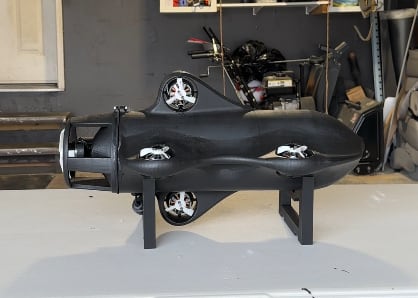
The prototype of the underwater autonomous drone created by Scrivens and Naphade. (Lauren Kuivenhoven/CBC)
According to Scrivens, a key feature that distinguishes their drone from standard underwater models is its portability, allowing it to be carried like a surfboard.
Kleperis mentioned that the drones will be deployed in several locations, including Aquarius Reef Base, an underwater research facility off Florida’s coast.
The drones will be utilized to patrol the area and monitor marine life, including the presence of sharks and other fish species.
Currently, Scrivens and Naphade are accumulating funds to construct their first pilot model based on the prototype. This pilot will be provided to operators, such as TEKMARA.