

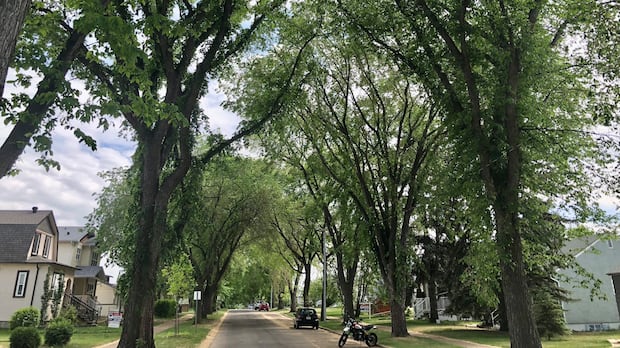

A specialist in forest health has warned that Edmonton’s current strategy for addressing Dutch elm disease may lead to significant long-term consequences for the city’s tree canopy.
Since the beginning of 2024, Edmonton has documented 16 instances of Dutch elm disease, with nine of those cases identified this year alone.
Elm trees constitute roughly 22 percent of the municipal tree canopy in Edmonton, predominantly comprising American elm trees.
Although they are not indigenous to Alberta, American elm trees are recognized for their tall, vertical growth and expansive canopy, making them a favored choice for urban environments.
The pathogen responsible for the disease, a fungus carried by bark beetles, impedes the trees’ ability to transport water, ultimately causing them to wilt and perish.
At present, Edmonton’s strategy focuses on the removal of trees that show signs of infection. As a preventative measure against the disease’s spread, elm trees located within a 20-meter radius of infected specimens are also being cut down, even if they appear healthy.
Nadir Erbilgin, a professor specializing in forest health at the University of Alberta, argues that the city’s current method is not the most effective. He advocates for the introduction of trap trees to target the source of infection: the bark beetle.
“If I discover an infested tree, I will lure it with a substantial amount of bark beetle pheromones to attract many beetles,” Erbilgin explained. “After that, we should cut it down, burn it, and eliminate it.”
The trap tree method aims to draw as many disease-carrying beetles to the trap as possible. Once the tree becomes infested, it is subsequently removed and incinerated, thereby decreasing the population of beetles that could spread the disease.
He cautioned that the removal strategies employed by several cities across North America could ultimately result in the loss of more healthy trees than the disease itself, including those that may have some resistance to it.
Mike Jenkins, a senior scientist with the City of Edmonton, acknowledged that the city’s current approach does lead to the removal of healthy trees.
“Unfortunately, in Rossdale specifically, we tested two trees that came back positive,” Jenkins stated. “We ended up removing around eight trees, many of which were large, mature elms.”
Jenkins noted that the city’s heightened vigilance on this issue is enabling them to identify the disease early, thus preventing its further spread.
“We have teams inspecting every public and private elm tree at least once a year,” Jenkins said. “In areas surrounding where detections have occurred, those trees are checked monthly.”
He indicated that the city plans to start incorporating trap trees into its strategy next year, focusing on Siberian elms.
Jenkins mentioned that there aren’t many Siberian elms within city limits, with most found on private property.
“The majority of Siberian elms are in backyards,” Jenkins remarked. “They tend to be a bit scraggly, resembling bushes.”
Jenkins pointed out that many Siberian elms are actually resistant to Dutch elm disease, and the deadwood from these trees can allow beetles to thrive and infect healthy American elms.
Until the trap tree strategy is implemented, the city plans to concentrate on pruning as much deadwood from Siberian elms as possible during the dormant season this fall to prevent the emergence of beetles in the spring.
Looking Ahead
As the city strives to manage the escalating issue of Dutch elm disease, residents are encouraged to contribute to the effort.
Sarah Mendonca, sales manager for Trusty Tree Services, emphasized that residents should maintain a regular care schedule for their elm trees and have them inspected every few years.
She also advised residents to look for signs of wilting leaves, any branches exhibiting a blue tint at their base, or visible scratches in the bark caused by beetles burrowing into the wood.
In Edmonton, pruning of elm trees is prohibited from April 1 to September 30. Jenkins clarified that while complete removal of elm trees is still permitted during this time, residents should refrain from storing any of the wood.
Elm wood can be disposed of at the Edmonton Waste Management Centre, and any trees suspected of having Dutch elm disease should be reported to the city.