

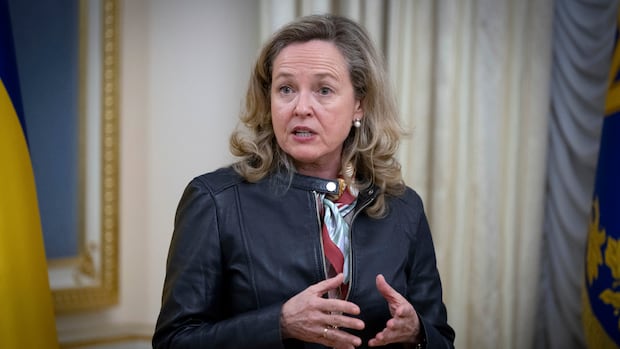

According to the president of the European Union’s investment bank, the moment has come to enhance collaboration with Canada by looking into ways to finance Canadian initiatives — remarks that coincide with Prime Minister Mark Carney’s call for stronger ties with the EU.
Nadia Calviño, the president of the European Investment Bank (EIB), stated, “We haven’t been particularly active in Canada up to this point,” during an exclusive interview on Rosemary Barton Live that was broadcasted on Sunday morning.
While in Canada to meet with several federal ministers, Calviño expressed that her visit “clearly demonstrates that in Europe, we put our money where our mouth is.”
Calviño highlighted that the initial area of mutual interest is critical minerals. She mentioned that the EIB is investigating the possibility of establishing a framework agreement to allow investment in critical minerals “and beyond.”
“I believe the primary concept is one that Prime Minister Carney is advocating, which centers around strategic alliances and cooperation,” Calviño told host Rosemary Barton. “We share common values and a common language.”
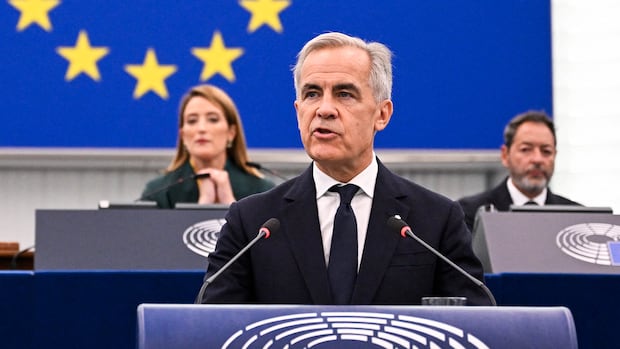
A day after Canada was invited to consider ‘associate membership’ in the EU, Prime Minister Mark Carney delivered a speech at the European Parliament emphasizing the need for stronger ties with Europe, although specifics remain uncertain.
When asked whether the EIB might invest in future oil and liquefied natural gas pipelines, Calviño stated that the bank has “established itself as the climate bank” and is “far more interested in innovative technologies” and renewable energy production.
Calviño’s remarks follow Carney’s Canada Investment Summit, which the federal government claims garnered nearly $500 billion in fresh investments for Canadian businesses and infrastructure.
In addition, Carney is advocating for Canada to strengthen its relationship with the European Union, although the precise details of his strategy remain vague.
-
What we know about the proposed partnership between Canada and the EU
-
Canada won’t pay directly into EU budget under Carney’s plan: ambassador-designate
On Thursday, Carney addressed the European Parliament, aiming to establish “seamless, digital” trade in non-agricultural goods and services, enhance cooperation on computing capabilities and AI safety measures, and investigate a unified market for financial services.
Nonetheless, opposition parties are questioning if Canada will have to make any concessions, particularly after European Commission President Ursula von der Leyen remarked that Canada could gain “associate membership” — a term without legal standing.
Calviño mentioned that she would not spend time on “the process, the procedures, the labels [and] the headlines,” asserting that the EIB is “a very practical organization.”
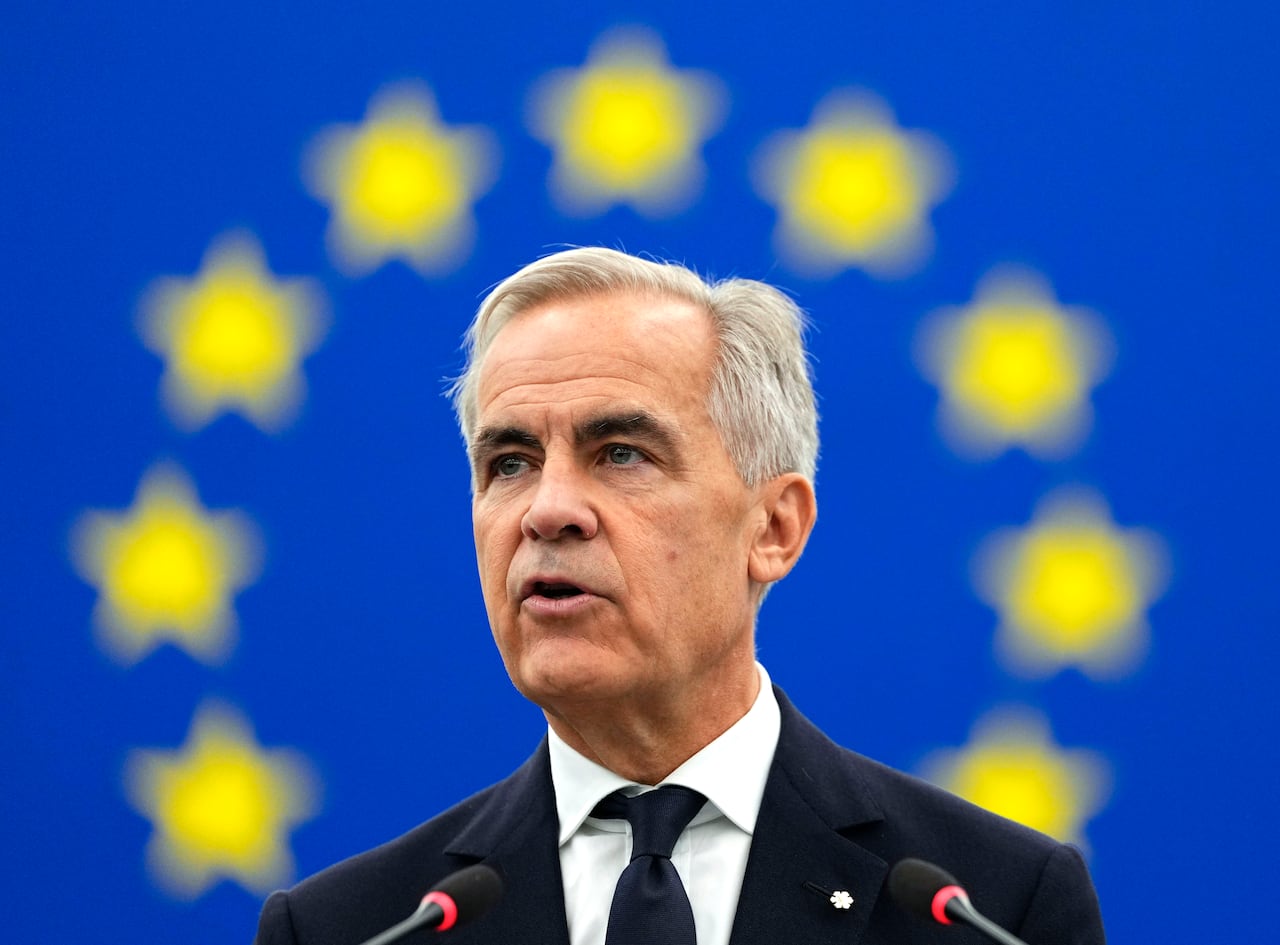
Prime Minister Mark Carney addresses the European Parliament in Strasbourg, France, on Thursday. (Justin Tang/The Canadian Press)
“We make investments. We allocate funds. We support initiatives. We bring projects to fruition. I think that aligns closely with Canada’s approach,” Calviño stated. “I would say the sky’s the limit.”
In a recent interview with CBC’s The House, Jonathan Wilkinson, Canada’s ambassador-designate to the EU, dismissed the idea of Canada contributing directly to the budget of the 27-member bloc.
“It encompasses several specific areas that the prime minister delineated as strategic capabilities — domains where countries need access to resources that empower them to make independent decisions,” said Wilkinson, who is set to assume his new role in the coming weeks.
Latvian MEP offers perspective
Rihards Kols, a Latvian member of the European Parliament, shared with Barton in a separate interview that Carney’s initiative towards the EU is a “geopolitical necessity in the current climate.”
“For the past two decades, democracies around the world are experiencing a decline. We are a minority, I would assert. It is essential for us to unite,” Kols remarked.
However, Kols expressed curiosity regarding the opinions of other Canadian politicians on this matter, and how they envision the future of the Canada-EU relationship.
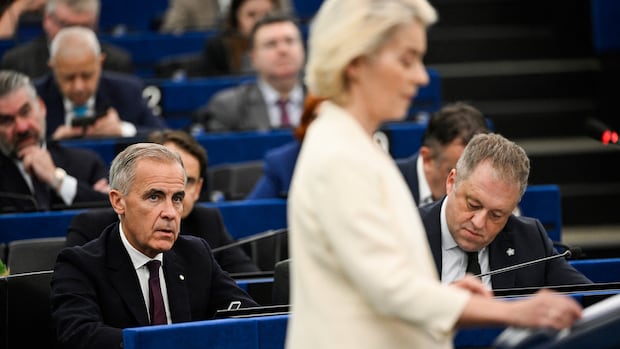
European Commission President Ursula von der Leyen presented Canada with a potential route to ‘associate membership’ in the 27-member bloc during Prime Minister Mark Carney’s visit to strengthen alliances, but Canadian officials indicate they are not yet ready to proceed with that level of engagement.
“We generally recognize that this is a natural partnership, and we should not postpone any of these cooperative aspects to bring the EU and Canada closer together,” Kols asserted.
Moreover, various European politicians who have communicated with CBC News recently have voiced their support for Carney’s proposal, yet some express concerns that a formal arrangement may lead to lengthy negotiations that yield minimal outcomes.
Instead, these European politicians argue that the emphasis should be on strengthening relationships — in areas such as diplomacy, culture, and academic collaboration — rather than getting caught up in formal processes.
Additionally, there is the matter of U.S. President Donald Trump, who has referred to the Canada-EU concept as “laughable.” He has also threatened new tariffs if he perceives the arrangement as a “hostile act.”
In his address, Carney remarked that Canada is not “seeking to form a third bloc to become a great power — merely with better etiquette.”
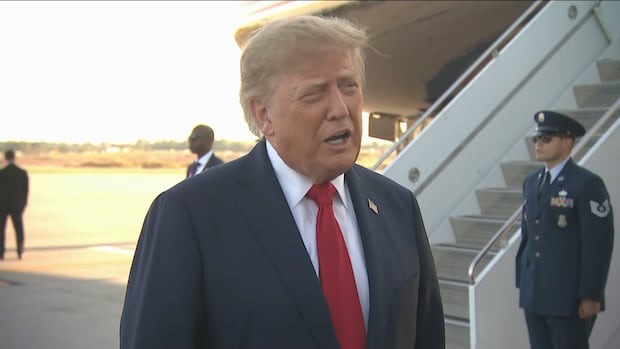
U.S. President Donald Trump has warned the European Union of ‘serious tariffs’ or potential cessation of trade if it reaches a deal with Canada ‘with bad intentions.’
“We do not aspire to power for the purpose of dominating others. Instead, we are aiming for resilience so that no one can control our open markets, compromise our sovereignty, threaten our territorial integrity, or undermine our freedoms, democracies, or rule of law.”
Calviño remarked that it is hard to determine if Canada and the EU would be pursuing closer relations without the backdrop of Trump’s trade conflict, but there is now a strong resolve among global partners to make progress.
“Everyone’s looking at Europe and wishes to collaborate with Europe because we aim to continue building a world founded on mutual respect and beneficial partnerships,” Calviño expressed.
“We are robust; the European Union is robust; Canada is robust. But together, we are even stronger.”