

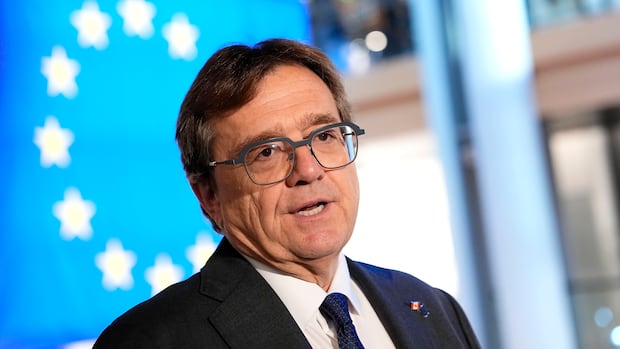

As Prime Minister Mark Carney aims to establish a “distinct partnership” with the European Union, Canada’s representative has dismissed the idea of contributing directly to the budget of the 27-nation bloc.
“We would be very selective,” Jonathan Wilkinson, Canada’s soon-to-be EU ambassador, stated in an interview with CBC’s The House that aired on Saturday morning. “This will not be a blanket approach. It certainly does not imply EU membership.”
Nonetheless, Wilkinson mentioned that certain programs may necessitate some level of financial support. He cited the EU’s Security Action for Europe (SAFE) initiative, which provides loans to member nations for defense-related investments.
Canada currently stands as the sole non-European participant in this program. Wilkinson noted that there are additional avenues for collaboration, such as boosting Canada’s capacity to market critical minerals through European investments or cooperating with the EU on artificial intelligence and other digital technologies.
“It encompasses several specific domains that the Prime Minister has identified as strategic capabilities—those areas where nations must have access to particular resources that empower them to make sovereign choices,” Wilkinson explained, as he prepares to take on his new position in the upcoming weeks.
Carney publicly expressed his desire to bring Canada closer to the EU during his address to the European Parliament on Thursday. He unveiled several aspects of his vision, which include:
- “Seamless, digital” trade in non-agricultural products and services.
- Canadian participation in Erasmus+, the EU’s initiative to foster education, training, youth, and sports in Europe, which features cross-border student exchanges.
- Canadian involvement in the next iteration of Horizon, the EU’s funding program for research and innovation. Canada currently has limited access to the existing program, which concludes after 2027.
- Collaboration on computing capacity, broadband connectivity, and AI safety protocols.
- Investigating a unified market for financial services.
However, it remains uncertain if Canada will be required to concede anything in exchange or if EU member states and the Canadian Parliament would endorse the agreement. Carney has assured that there will be a parliamentary vote and debate regarding the framework of any alliance with the EU.
Wilkinson expressed he would be “very careful” in making assumptions about significant concerns raised by some opposition parties, such as whether Canada would need to modify migration policies.
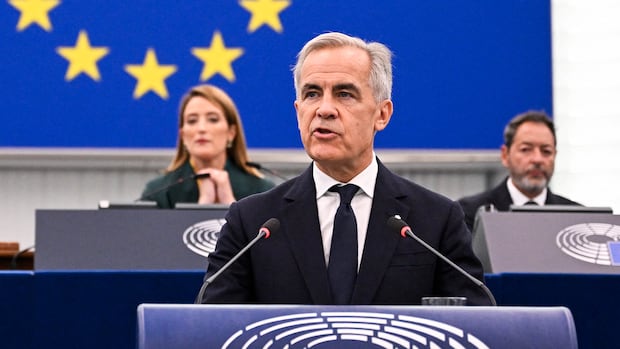
A day after the possibility of Canada becoming an ‘associate member’ of the EU was introduced, Prime Minister Mark Carney addressed the European Parliament, affirming his commitment to strengthening ties with Europe, although uncertainties linger regarding the specifics.
“Are we discussing mass movement between the two regions? No, and the notion that it somehow relates to the irregular migration challenges in Europe… The borders in Canada are vastly different from those in Europe,” Wilkinson remarked.
“Canada will completely maintain its sovereignty.”
Reactions from European Politicians
Thomas Byrne, Ireland’s minister of state for European affairs and defense, told The House that both parties share many common values, including commitments to democracy, free trade, and the rule of law.
“We recognize that the U.S.A. is no longer as committed to the kind of tariff-free trade we advocate as it once was. Hence, we must cultivate alternative partnerships,” Byrne stated. “This creates a significant level of commonality between us.”
- Cross Country Checkup is asking: Is Canada more like Europe than the United States? What’s at stake for you if Canada builds closer ties to the EU? Leave your comment here and we may read it or call you back for Sunday’s show
Byrne also expressed that what is currently being considered is mutual advantages for both parties, rather than imposing responsibilities on one another.
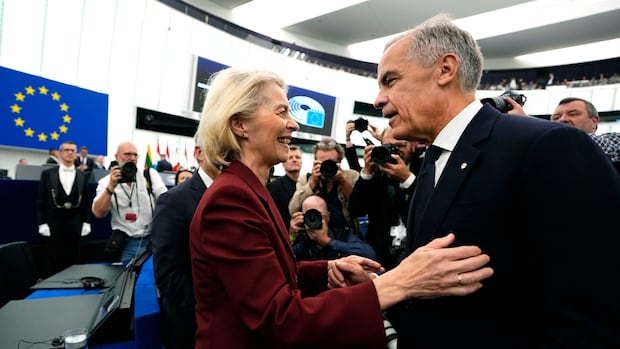
Prime Minister Mark Carney spoke to the European Parliament, asserting that a partnership between Canada and Europe would ‘safeguard our abilities to live our lives as we choose.’ Roland Paris, a foreign policy adviser to Justin Trudeau during his tenure as prime minister, and Arash Saeidi, a member of the European Parliament, discuss the potential implications of an alliance between Canada and the EU.
“We are equal partners across the Atlantic,” Byrne commented.
Conversely, Arash Saeidi, a member of the European Parliament from France, expressed his apprehensions regarding the proposal, stating, “If we engage in this discussion, we will waste our time and it will drag on for ten years without any progress.”
Instead, Saeidi emphasized that the focus should be on actively strengthening relationships in areas such as diplomacy, culture, and academic research, rather than deliberating a formalized process.
The Trump Factor
An obstacle to Carney’s initiative is U.S. President Donald Trump, who dismissed the prospect of closer Canada-EU relations as “laughable” and subsequently threatened fresh tariffs if it is perceived as “a hostile act.”
“It is reasonable to assert that Europe will pursue its own interests,” remarked Fen Osler Hampson, co-chair of the Expert Group on Canada-U.S. Relations.
“Numerous Europeans are already advocating for enhanced European strategic independence from the United States for similar reasons as we are.”
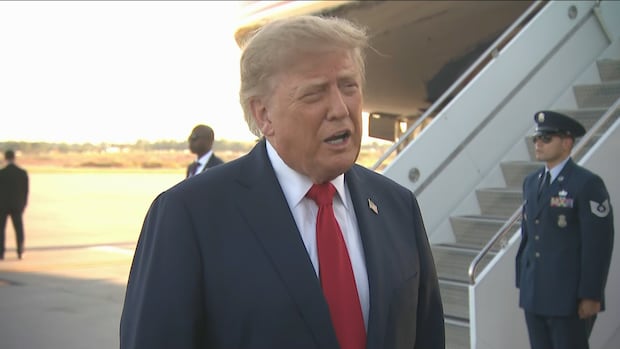
U.S. President Donald Trump warned the European Union of ‘very serious tariffs’ or a potential halt in trade if it proceeds with a trade agreement with Canada ‘with bad intentions.’
Hampson added that Trump should keep in mind that both Europe and Canada are significant investors in U.S. equity markets, and Canada owns a substantial portion of U.S. debt.
“Thus, when he speaks of cutting off trade… If he follows through, he would be harming his own interests,” he remarked.
When asked if Trump’s threats might deter the EU from reaching a deal with Canada, Wilkinson stated, “I suppose it’s up to the Europeans,” though he expressed skepticism about such an outcome.
-
FRONT BURNER
Is a shaky U.S. bond market good for Canada?
-
Far-right German politician heckles Carney with ‘U.S.A.’ chant before EU address
Carney emphasized in his address that Canada is not “seeking to form a third bloc to assert itself as a great power — merely with better manners.”
“We do not aspire to dominate others. Rather, we are striving for resilience so that no one can control our open markets, compromise our sovereignty, threaten our territorial integrity, or undermine our freedoms, democracies, and rule of law.”
Tag: rewrite-pending