

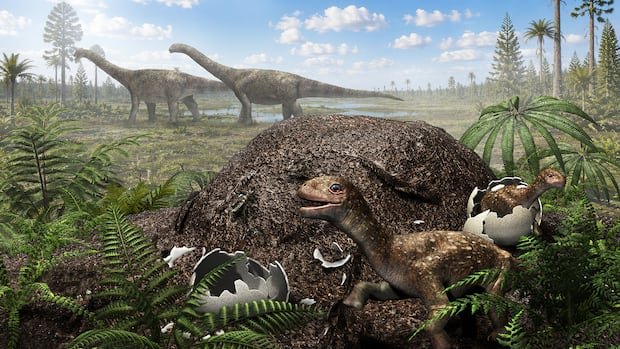

Fossil eggshells from some of the largest dinosaurs ever discovered have been unearthed in a surprisingly cool climate, far away from the equator. Despite their massive size, these titanosaurs couldn’t rely on incubating their volleyball-sized eggs by sitting on them, as they were too large, as explained by University of Calgary paleontologist Darla Zelenitsky.
A recent study led by Zelenitsky, in collaboration with researchers from Japan and Argentina, delved into the microscopic details of the eggshells to uncover how titanosaurs managed to keep their eggs warm enough to hatch. The researchers propose that titanosaurs likely utilized a similar incubation technique to modern crocodiles, burying their eggs in warm piles of decomposing vegetation.
Titanosaurs were colossal, herbivorous dinosaurs with long necks and tails that roamed on four legs, weighing up to 75 tonnes, akin to half the mass of a blue whale. Fossilized volleyball-sized eggs known as Fusioolithus have been associated with titanosaurs, previously found abundantly in warmer climates.
Recent discoveries of Fusioolithus eggshell fragments in the Chorrillo Formation in southern Argentina date back to the Late Cretaceous period, just before the dinosaurs’ extinction, indicating a climate similar to present-day New York City. The region housed diverse dinosaur species, including the massive Nullotitan glaciaris and smaller herbivores like Isasicursor santacrucensis, coexisting with various other prehistoric creatures.
The study sheds light on how dinosaurs, including large titanosaurs like Nullotitan glaciaris, adapted to nesting in diverse environments, showcasing their remarkable ability to survive and reproduce under challenging conditions without relying on traditional incubation methods. Further research into titanosaur nesting behaviors across different regions and time periods could provide valuable insights into their evolutionary success.
Tsu-Ruei Yang, an expert in vertebrate paleontology, suggested that the nesting strategies of titanosaurs might have varied across different regions and time periods, influencing their global spread during the Late Cretaceous era. A comprehensive study focusing on titanosaur nesting habits could offer a deeper understanding of their diverse adaptations and evolutionary strategies.