

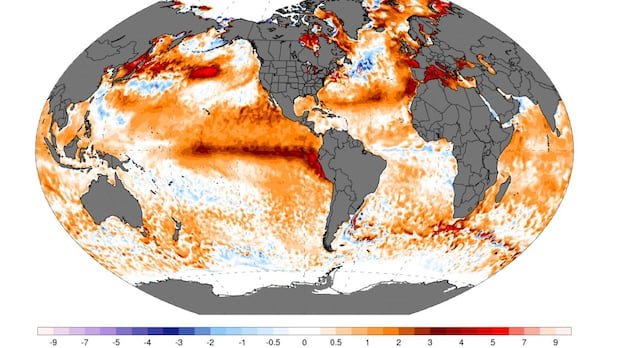

The much-anticipated El Niño has arrived, and it is already proving to be significant. Earlier this year, climate experts had predicted the development of an El Niño in the central Pacific region. Over time, numerous models indicated the likelihood of an exceptionally strong or “super” El Niño, though scientists cautioned that it was premature to confirm. In June, the U.S. National Oceanic and Atmospheric Administration (NOAA) released its monthly update, officially declaring an El Niño advisory as warmer conditions emerged in the specific area of the Pacific Ocean known as Niño 3.4.
For an event to qualify as an El Niño, temperatures in the designated zone must surpass the average by 0.5 degrees Celsius. Currently, ocean temperatures are nearly 2 degrees Celsius above average, surpassing historical records for this time of year. Zeke Hausfather, a climate scientist from Berkeley Earth, highlighted that temperatures in the Nino 3.4 region have exceeded 2 degrees Celsius, indicating the potential for a very strong or “super” El Niño, even in early July.
El Niño and La Niña are components of the larger El Niño Southern Oscillation (ENSO) cycle, occurring in the Pacific Ocean. While La Niña brings cooler temperatures, El Niño ushers in warmer conditions. Projections suggest that the peak of this El Niño may occur in October, with many models hinting at a peak in November or December.
The most robust El Niño in recent memory was in 2015-2016, with an ocean temperature anomaly of approximately 2.75 degrees Celsius. Nat Johnson, a meteorologist at NOAA, noted the swift transition from La Niña to El Niño, a remarkable change over a single year. Speculations indicate that the upcoming El Niño could break records by a significant margin.
While the possibility of a 4-degree Celsius increase initially seemed implausible, current models suggest a peak around 3.6 degrees Celsius, surpassing historical El Niño strengths. The role of climate change in these extreme conditions remains uncertain, as scientists debate its potential influence. Concerns persist regarding the impact on food security in tropical regions experiencing droughts and the potential for milder but drier conditions in Canada, posing wildfire risks.
In summary, the current El Niño poses substantial implications, especially for agriculture, ecosystems, and climate patterns, emphasizing the need for preparedness and awareness of its potential effects.
This article was rewritten to enhance readability and SEO optimization.