

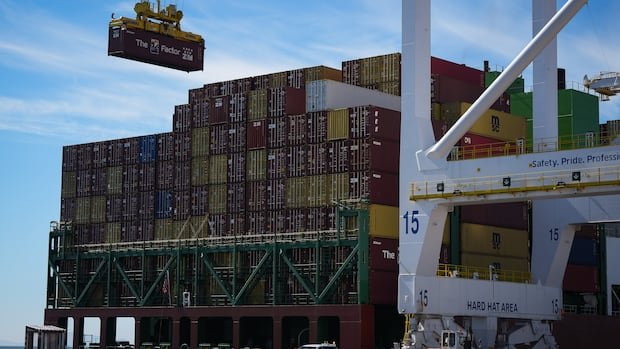

As the clock ticks down for Canada to finalize a trade agreement with the United States, many Canadian businesses are feeling anxious, anticipating a potential loss of up to half of their sales if the new tariffs are imposed. The impending U.S. tariffs, scheduled to come into effect on Wednesday, would impact a wide range of Canadian products, including electronics, dairy, alcohol, and wood, totaling $28 billion.
Negotiations are intensifying as the deadline approaches, with Canadian officials likely to meet U.S. Trade Representative Jamieson Greer before Prime Minister Mark Carney and President Donald Trump discuss the situation. The final decision on any deal rests with President Trump, according to sources familiar with the talks.
Some Canadian businesses fear that the proposed tariffs could not only increase prices for American customers but also render cross-border shipping economically unviable. Todd Stafford, president of Northern Cables based in Brockville, Ontario, relies on U.S. buyers for about half of the company’s sales, primarily specializing in manufacturing copper and aluminum power cables for commercial and industrial purposes.
Stafford expressed concerns that if the new tariffs are implemented, the company would be forced to halt all cross-border shipments, potentially leading to significant business losses. Despite having managed to avoid layoffs for the past 26 years, Stafford worries about the adverse effects the tariffs could have on the company, such as impacting construction projects and facing competition from cheaper Chinese products.
Impact on CUSMA Shield
Since the beginning of his second term in January 2025, President Trump has targeted key sectors of the Canadian economy with tariffs on items like auto parts, lumber, steel, and aluminum. However, the majority of cross-border trade has been shielded under the Canada-U.S.-Mexico Agreement (CUSMA), signed by Trump in 2020, significantly mitigating the trade war’s repercussions on Canada.
The upcoming tariffs are expected to affect approximately five percent of Canada’s overall trade with the U.S., impacting a variety of Canadian exports, including hockey sticks, flowers, and antiques. Notably, energy, potash, and critical minerals will remain exempt from the new tariffs.
Canadian Federation of Independent Business (CFIB) Vice President Jasmin Guénette emphasized that many business owners are deeply concerned about the potential revenue losses, highlighting the pivotal role CUSMA has played in shielding various sectors and businesses from trade disruptions.
Cindy Baldassi, owner of Calgary-based CindyLouWho2 specializing in handmade jewelry, fears losing a substantial portion of her business due to the tariffs. She has stopped shipping to the U.S. and is adjusting prices on her products in anticipation of the impact.
Despite efforts to boost domestic sales, Baldassi relies heavily on American customers, lacking the resources for extensive marketing campaigns. With uncertainties surrounding the tariffs, the future of her business remains uncertain.
Guénette noted a growing trend among Canadian businesses to explore non-U.S. markets, reflecting a diminishing trust in the U.S. as a reliable trade partner.
Preemptive Business Responses
While the new tariffs have yet to be enforced, some business leaders have already felt the repercussions. Randy Williams, director of sales and marketing at Monterey Textiles, highlighted the impact of the tariff threat on businesses, noting instances of layoffs and reduced orders.
Lorne Prins, owner of Gull Lake Honey in Alberta, is observing a rush among honey producers to ship to the U.S. before the tariff deadline. Concerns loom over potential surplus honey in Canada if U.S. sales are disrupted, affecting local prices and necessitating support for Canadian businesses.