

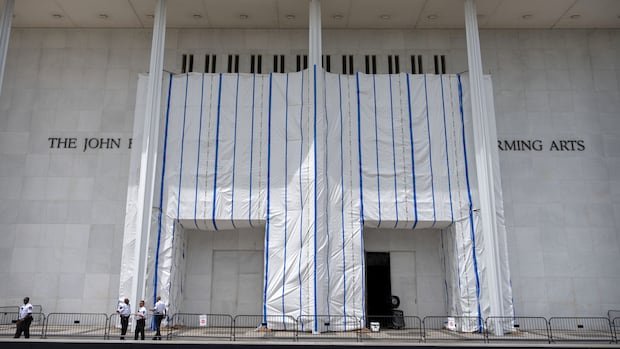

The dispute surrounding the future of the Kennedy Center intensified on Thursday as supporters of U.S. President Donald Trump within the board made moves to honor him by making physical alterations to the renowned performing arts venue that could violate a court ruling. In a lengthy virtual meeting, the board approved the addition of Trump’s name to the building’s facade, proposing it to be renamed as “The John F. Kennedy Center for the Performing Arts Restored and Renovated By President Donald J. Trump.” Additionally, they suggested naming the plaza in front of the building after Trump and planning a significant closure of the venue for two years to facilitate substantial renovations.
These actions, as described by Representative Joyce Beatty, a Democratic board member from Ohio, and her legal team, represent a bold challenge to U.S. District Judge Christopher Cooper. Cooper had previously ruled in May that the installation of letters spelling out Trump’s name on the building was unauthorized, ordering their removal, a decision that the Trump administration could not reverse through legal channels. Furthermore, Cooper blocked a two-year closure scheduled to begin on July 5, criticizing the board’s decision as uninformed and predetermined.
Beatty condemned the recent developments as an attempt to circumvent the court’s ruling and defy congressional statutes. She vowed to continue advocating for the preservation of the historic monument. The Kennedy Center’s spokesperson did not provide an immediate comment on the matter.
Much of the board meeting revolved around deliberations on the necessary closures for essential renovations to enhance safety, as emphasized by the center’s management. Responding to the critique from the judge regarding the previous closure decision, the institution’s leaders presented the board with three options for consideration. These options included a complete closure, a partial closure allowing limited public access and programming, and a phased closure focusing on critical infrastructure needs while maintaining programming.
Ultimately, the board opted to close the building for two years while potentially allowing some programming in the outdoor space known as the Reach. This decision, in conjunction with the efforts to honor Trump, may raise concerns about the board’s thorough evaluation of alternative options.
In parallel with the Kennedy Center developments, Trump’s initiatives in reshaping Washington, D.C.’s physical landscape have garnered attention. Following his return to office, Trump swiftly replaced the Kennedy Center’s leadership and inserted his name on the building, a move that was later undone in compliance with the court ruling. Trump’s broader urban transformation plans involve controversial projects such as the White House East Wing demolition, the construction of a disputed ballroom, and renovation efforts at the Lincoln Memorial Reflecting Pool. Despite facing setbacks and legal challenges, Trump remains committed to his vision for architectural changes in the capital.
The Kennedy Center’s leadership has underscored the urgent need for repairs and updates within the facility. Executive Director Matt Floca highlighted severe water damage and outdated equipment during a tour, emphasizing the necessity for comprehensive renovations over piecemeal repairs. The decision to close the building for renovations aligns with the management’s recommendation to ensure a thorough and efficient restoration process.
As legal battles persist, the Kennedy Center’s significance as a cultural hub accessible to all Americans has been emphasized by trustee Pamella Roland DeVos, appointed by Trump. The institution’s commitment to providing a platform for artistic expression and cultural enrichment remains a focal point amid the ongoing controversies.