

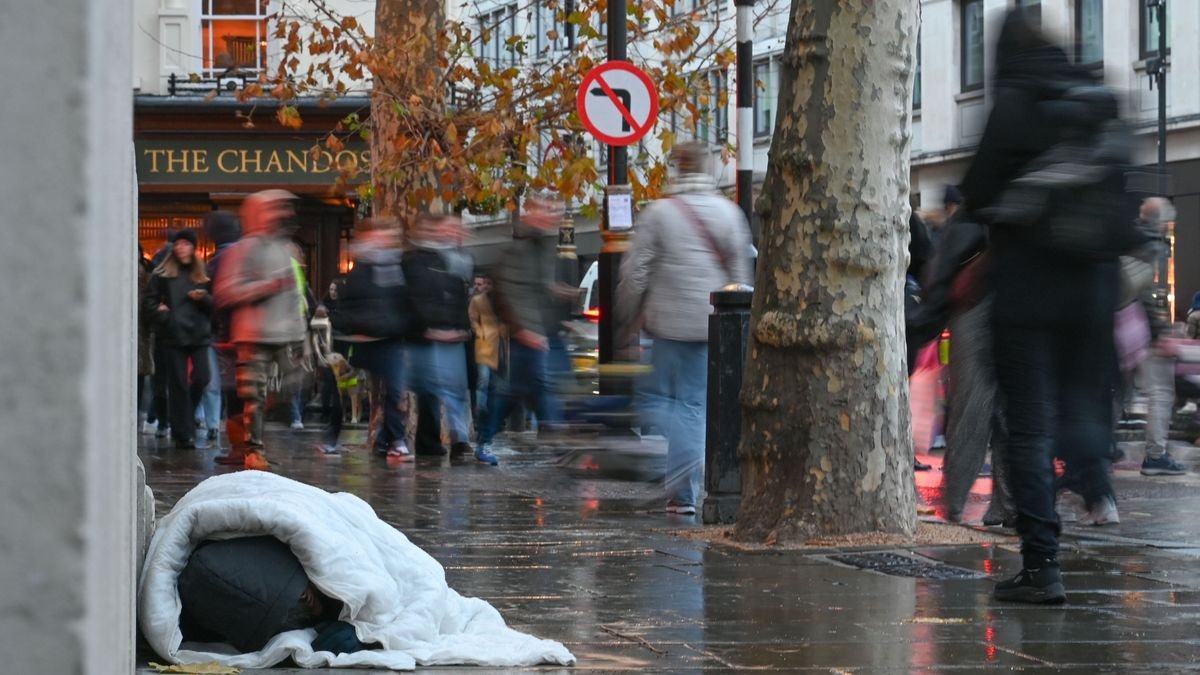

Ministers have made a commitment to reduce by 50% the number of individuals compelled to sleep on the streets and put an end to the troubling issue of families being stuck in B&Bs. This initiative is part of a new comprehensive homeless strategy revealed today, supported by a £3.5 billion budget, aimed at addressing the problem of rough sleepers.
The National Plan to End Homelessness encompasses three main goals to be accomplished by the conclusion of this parliament – cutting in half the count of long-term rough sleepers, abolishing the improper use of B&Bs for families, and preventing additional households from facing homelessness initially.
Among the outlined objectives is the aspiration to decrease by half the number of former prisoners experiencing homelessness on their first night post-release and ensuring that no eligible person is discharged onto the streets following a hospital stay.
Recent findings disclosed by the Daily Mirror showcased a disparity where nearly double the number of women are sleeping rough compared to official statistics.
With Christmas approaching, the government highlighted the harsh reality confronting many individuals, whether it be someone bedding down on the streets or children struggling in temporary housing.
The plan also alludes to a commitment stated in the recent child poverty strategy to eliminate the unlawful utilization of B&B accommodation for families.
Statistics from the most recent data indicated that by the end of June, there were 2,070 households in England with children exceeding the six-week limit in temporary housing.
In the words of Housing Secretary Steve Reed, “Homelessness poses one of the most significant challenges to our society, as fundamentally, it concerns people. Families deserve stability, children require a secure environment to grow, and individuals simply seek the dignity of a home.”
“This strategy is informed by the voices of those who have endured homelessness and the frontline workers who tirelessly combat it,” Reed emphasized.
Through this new strategy, the aim is to foster a future where homelessness is infrequent, brief, and non-repetitive.
The strategy coincides with housing charity Shelter’s assertion that 382,618 people in England, including 175,025 children, will spend this Christmas without a home. Shelter combined official homelessness data with responses from Freedom of Information requests to local authorities, estimating that on any given night this year, one out of 153 individuals will be recorded as homeless.
The total number reflects an 8% increase from 2024, with 350,480 individuals in temporary accommodation in 2025, constituting a form of homelessness. Moreover, at least 4,667 individuals were reported to have slept rough on any given night, marking a 20% rise over a year.
Long-term rough sleeping, as defined by the Centre for Homelessness Impact, pertains to individuals seen on the streets within the reporting month and over three or more months within the past year.
The announcement also allocates an additional £37 million to enhance support and services from voluntary, community, and faith sectors, acknowledged as crucial players at the forefront of this crisis.
Local authorities will receive a boost of £950 million to bolster the availability of high-quality temporary accommodations, while £30 million will be directed towards preventing the use of substandard emergency housing.
Homelessness minister Alison McGovern emphasized, “By collaborating with government, local leaders, charities, and communities, we can prevent homelessness and ensure swift and effective support for those in crisis.”
“The potential benefits are substantial. Presently, taxpayers bear the cost of failure, as expenses for temporary accommodations soar,” McGovern pointed out.
“This strategy charts a path towards saving money and transforming lives,” she concluded.
Although housing charities welcomed certain aspects of the strategy, they cautioned that more action is necessary, including unfreezing housing benefits and a commitment to building 90,000 new social rent homes annually for a decade.
Shelter’s chief executive Sarah Elliott commended the Government for giving due attention to this critical issue but stressed the urgent need for a plan to relocate those currently in temporary accommodation or on the streets to safe residences.
“To achieve success with the Government’s strategy, the primary aim should be the eradication of homelessness altogether,” Elliott remarked.
“This demands the unfreezing of housing benefits for immediate assistance and the delivery of 90,000 new social rent homes annually for ten years,” she added.
Crisis described the strategy as a positive step forward but pointed out significant gaps that need addressing. The charity’s chief executive, Matt Downie, underscored the importance of addressing the root causes of homelessness through a more comprehensive approach from other government sectors.
Big Issue founder Lord John Bird expressed support for the Government’s efforts on homelessness prevention but urged a deeper examination of the systemic issues leading to housing insecurity.