

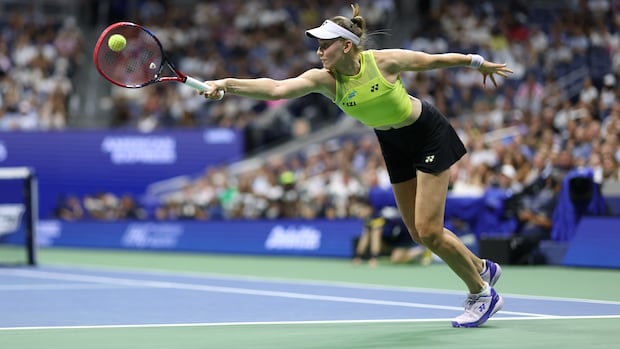

Aryna Sabalenka acknowledged that she was likely to lose her No. 1 ranking to Elena Rybakina, a situation beyond her control.
However, the U.S. Open trophy is a different matter entirely.
Rybakina can only claim that honor from Sabalenka by winning the title on Saturday, and the two-time defending champion demonstrated her determination for a three-peat with a dominant performance in the semifinals — a feat that hasn’t been accomplished at Flushing Meadows since Serena Williams did it from 2012 to 2014.
“I was really eager to reach the finals, and of course, I aim to go all the way,” Sabalenka stated.
Rybakina secured her place in the final by overcoming Coco Gauff with a score of 3-6, 6-4, 6-4. Sabalenka triumphed over Jessica Pegula 7-5, 6-2 in the first semifinal, dominating the second set after a closely contested first.
Currently, Sabalenka holds the No. 1 position, while Rybakina is ranked No. 2 in the WTA standings, but that will change on Monday after Sabalenka maintained her top rank for 99 consecutive weeks.
Rybakina began her season by winning the Australian Open, where she defeated Sabalenka, and continued to close the gap as the four-time Grand Slam champion struggled during the summer.
Rybakina only needed to reach the semifinals in New York to secure the No. 1 ranking.
“It requires a lot of effort, and yes, that was one of my goals, but right now there’s not much I can do. I didn’t perform well in the middle of the season,” Sabalenka reflected. “Elena took over and played exceptionally well, claiming the No. 1 position.”
The second semifinal was a more intense battle, with Gauff striving to come back in the last two sets, but Rybakina was determined not to let her fully recover.
Gauff started strong against Rybakina, hitting four aces to Rybakina’s one in a first set that lasted 38 minutes.
“I took a deep breath, tried to stay positive, and told myself that I needed to fight and showcase good tennis,” Rybakina shared.
Gauff fell behind 4-1 in the second set but fought back to level the score at 4-all before Rybakina won the next two games. Rybakina led 5-3 and served for the match, but Gauff broke back to give herself another shot, cheered on by a crowd that included former first lady Michelle Obama.
“I thought it was a good match, and it really came down to a couple of my service games in both sets where I couldn’t hold,” Gauff commented. “I need to review what went wrong, but she does an excellent job of being present at every point and applying a lot of pressure during service and return games.”
Gauff captured her first major title as a teenager when she came back to defeat Sabalenka in the 2023 U.S. Open final, but since then, no one has managed to defeat the Belarusian at Flushing Meadows. Pegula put up a commendable effort in the 2024 final and last year’s semifinals, but she couldn’t keep pace with Sabalenka’s performance on Thursday — and wasn’t sure if anyone else could have either.
“I think that’s definitely — you can ask her — probably the best match she’s played this year,” Pegula remarked. “I mean, her level was incredibly high.”
Sabalenka struck 29 winners compared to Pegula’s 12. She has now won 19 consecutive matches at the U.S. Open since her loss to Gauff in the 2023 final.
For the first time since 1975, all four top seeds advanced to the women’s semifinals at the U.S. Open. Sabalenka, Rybakina, and Gauff have each claimed multiple major titles, while Pegula is still in search of her first.
Sabalenka won 14 of 19 points on Pegula’s second serve, returning shots faster than they were delivered to her.
Nevertheless, Pegula managed to stay competitive for a time.
The score was already 4-all in just 25 minutes, and Sabalenka seemed to grow frustrated with her inability to break through Pegula’s serve, gesturing towards her coaches’ box in annoyance after a missed opportunity. Pegula had won 18 of her last 20 points on her first serve when she prepared to serve with Sabalenka ahead 6-5.
Sabalenka then delivered a backhand winner, Pegula sent a forehand long, and Sabalenka hit another winner to set up a set point, ultimately closing out the set shortly after.
In the second set, Sabalenka put Pegula under significant pressure during her second service game, ultimately taking advantage of a 77 mph second serve and blasting a forehand back at 90 mph, leaving Pegula with no chance to recover, giving Sabalenka a 3-1 advantage.