

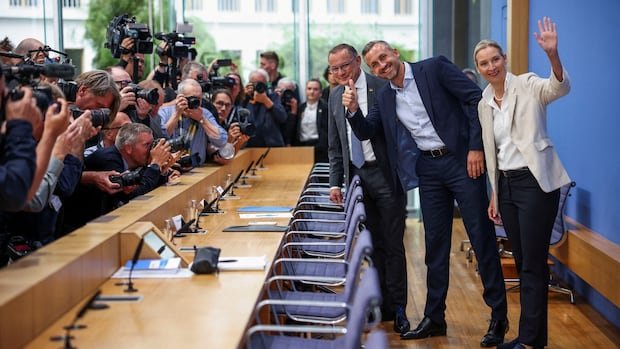

Voters in Saxony-Anhalt, a state in eastern Germany, have decisively elected the far-right Alternative for Germany (AfD) party to lead their government. This victory is significant as the AfD was previously considered a fringe populist party and labeled right-wing extremist by local intelligence agencies. The party’s success in the election is seen as a reflection of a growing distrust in mainstream politics in Germany and a signal to right-wing populist movements globally that they are gaining support.
Alice Weidel, the federal co-leader of AfD, expressed her excitement and pride in the party’s victory in Saxony-Anhalt, emphasizing the responsibility they now have not only in the state but across Germany. The AfD’s platform in Saxony-Anhalt includes plans to strengthen ties with Russia, prohibit Pride flags in schools, and establish separate classrooms for refugee children, advocating for policies like “remigration.”
Acknowledging the win, prominent figures like Elon Musk and former U.S. President Donald Trump have reacted positively. Musk congratulated Ulrich Siegmund, the AfD candidate, for his win, while Trump shared the election results on his social media platform. The AfD’s admiration for Trump is evident in their campaign slogan “Make Saxony-Anhalt Great Again,” echoing Trump’s political movement.
The AfD’s surge in Saxony-Anhalt has raised concerns about its pro-Russia stance and potential impact on German politics. Party members have been vocal in their support for Russia, with CEO Kirill Dmitriev praising the party for its approach to governance. However, critics warn that the AfD’s alignment with Russia could undermine Germany’s relations with other countries, particularly regarding the conflict in Ukraine.
The election outcome poses challenges for mainstream political parties in Germany, such as the Christian Democratic Union (CDU), which suffered significant losses in Saxony-Anhalt. The AfD’s rise signals a shift in German politics and could impact future coalition formations. The CDU and other parties have previously worked together to prevent the AfD from gaining power, but with the party’s increasing popularity, maintaining this “firewall” against right-wing extremism may prove challenging.
As Germany grapples with the implications of the AfD’s victory in Saxony-Anhalt, the country faces questions about its future political landscape and international relations. The election results highlight the deep-seated frustrations among voters and the need for established parties to address evolving political dynamics in the country.