

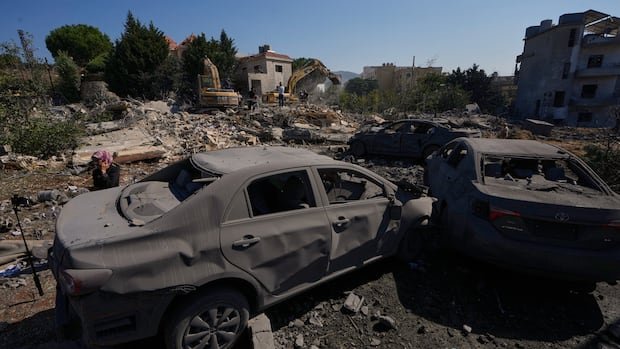

Israeli airstrikes in a southern Lebanese town resulted in the deaths of at least 12 individuals, including two children, early on Monday, according to Lebanon’s Health Ministry. This incident marked one of the deadliest days of Israeli attacks in recent weeks, raising concerns of a potential new Israeli military campaign in Lebanon despite a ceasefire agreement in June aimed at ending hostilities between the Israeli military and Hezbollah.
A witness related to the victims mentioned that one of the attacks targeted a residential building where children were preparing for school. The Israeli military stated that their strike targeted individuals observed transferring weapons in the vicinity of the town Kfar Rumman.
Following the airstrikes, rescue workers found schoolbooks scattered among the debris of the destroyed building. There was a frantic effort to retrieve bodies trapped under the rubble throughout the morning.
One young boy, Mustafa Farhat, lost his mother, grandparents, and potentially his father in the attack. As rescue operations continued to locate his father, Mustafa received medical treatment at a hospital. The boy’s relative, Mona Farhat, expressed disbelief at the attack on their home and questioned the intentions behind the assault.
According to Lebanon’s Health Ministry, 11 people, including children and women, lost their lives in the residential building strike. Additionally, a separate drone strike by Israel on a civilian vehicle in the same town led to the death of a medic and injuries to two others.
Notably, the Israeli military carried out the strikes without issuing an online evacuation warning. While asserting efforts to minimize harm to civilians through precise munitions and surveillance, the military acknowledged the reports of civilian casualties and committed to investigating the matter.
The Israeli military attributed the escalation to Hezbollah’s deployment of explosive drones toward Israeli troops near the Ali al-Taher ridge. Israel claimed to have removed Hezbollah fighters from the region previously, although Hezbollah has not commented on the situation. The ongoing violence has prompted increased Israeli strikes in towns near the ridge, leading to fears of further escalations in the southern region in the near future.
The cycle of violence in Lebanon has resulted in over 4,300 deaths since Hezbollah’s rocket attacks on Israel in response to U.S. and Israeli strikes on Iran in March. While a ceasefire reduced hostilities, Israeli forces have continued operations in southern Lebanon, causing destruction in villages within the security zone without prior warnings.