

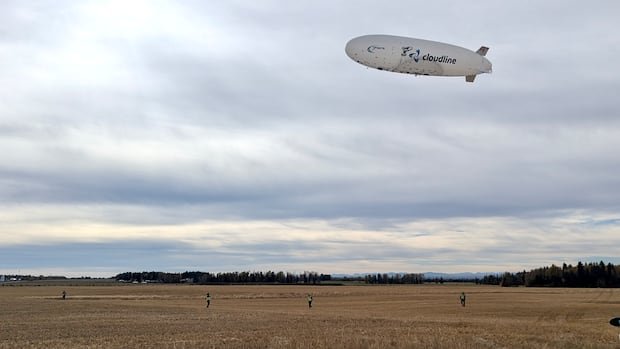

Last week, central Alberta witnessed an unusual spectacle in the sky that caught the attention of many onlookers: a 20-meter airship. While the sight of a Goodyear Blimp at a sports event is not uncommon, spotting such an aircraft in rural Alberta is a rare occurrence.
The airship, powered by solar energy and comparable in size to a school bus, was conducting aerial survey tests near Rocky Mountain House, approximately 200 kilometers southwest of Edmonton. A collaborative team from Cloudline, a South African aerospace company that built the airship, and its Canadian partner, 3 Points in Space Media, conducted flight trials at the Rocky Mountain House Airport.
Describing the airship as similar to a helium party balloon, Sean Adams, the CEO of 3 Points in Space Media, highlighted the innovative approach of combining control systems with the airship to create an autonomous aerial vehicle. The technology, although rooted in history, incorporates new advancements.
Flight preparations involve filling the airship envelope with helium, running diagnostic checks, and conducting calibration runs before embarking on survey flights covering long distances. The airship, classified as a remotely piloted aircraft system with automated flight controls, is particularly useful for data collection in remote areas such as monitoring pipelines and infrastructure, tasks traditionally performed by conventional aircraft or smaller drones.
Cloudline’s CEO, Spencer Horne, emphasized the airship’s significant payload capacity, enabling it to carry heavier camera and LiDAR sensors over extensive distances compared to standard drones. While crewed aircraft may excel in extreme weather conditions, efforts are underway to enhance the airship’s capabilities for such scenarios.
The research initiative, supported by TC Energy, aims to gather diverse data types efficiently during flights while maintaining a quieter operation than conventional aircraft. The next phase for the team involves cold-weather testing in northern Ontario to prepare the airship for sub-zero and Arctic conditions.
For Michael Adams, VP of Research and Development at 3 Points in Space Media, operating the airship represents a chance to revitalize a historic aviation technology that declined in the 1930s. To blend past and present, a piece of fabric from the Graf Zeppelin, a renowned airship from the 1920s, has been incorporated into the airship’s payload as a tribute to aviation history.
The presence of the airship in the Rocky Mountain House area generated considerable interest among locals. Mayor Shane Boniface expressed amazement at the sighting, emphasizing the novelty of the experience compared to a recent tornado event. While such autonomous airships operate internationally, their appearance in Canadian airspace remains infrequent.
In conclusion, the successful operation of the airship near Rocky Mountain House marks a significant milestone in the utilization of advanced aerial technology for data collection and monitoring purposes.