

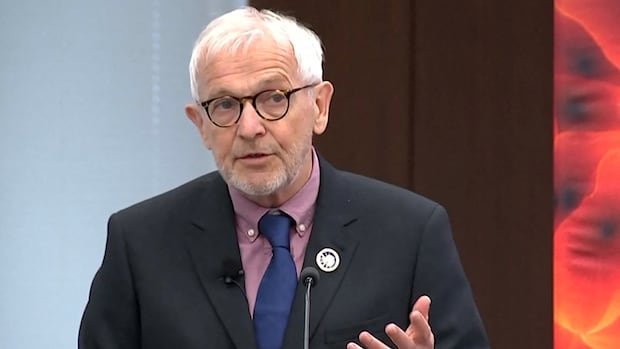

Belgian American physicist Francis Halzen, aged 82, has been named the recipient of the 2026 Nobel Prize in Physics in Stockholm. The prestigious award recognized Halzen for his significant contributions to the IceCube Neutrino Observatory and the breakthrough discovery of high-energy neutrinos originating from space. Situated at the Amundsen–Scott South Pole Station in Antarctica, the observatory was a realization of Halzen’s innovative idea to utilize ice at the South Pole for neutrino tracking.
Eva Olsson from the Royal Swedish Academy of Sciences highlighted the importance of these “ghost particles” in providing insights from distant galaxies and the phenomena of exploding stars. The Nobel Physics Prize, which comes with a cash prize of 12 million Swedish crowns ($1.7 million Cdn), is awarded annually by the Royal Swedish Academy of Sciences.
The IceCube Neutrino Observatory, covering a cubic kilometer, commenced operations in 2011, culminating from a vision conceived in the late 1980s. Halzen expressed gratitude to his collaborators over the years, acknowledging the skepticism initially surrounding the project’s success.
An internationally acclaimed particle physicist affiliated with the University of Wisconsin–Madison, Halzen was pleasantly surprised by the announcement while attending a conference in Italy. Referred to as “Neutrino Man” by the U.S.-based Smithsonian magazine in 2014, Halzen’s work revolves around studying neutrinos, enigmatic cosmic particles offering insights into the universe’s evolution.
The IceCube-Gen2 extension project, slated for operation in 2033, is set to amplify neutrino detection capabilities tenfold over an area of eight cubic kilometers of ice. Halzen remains optimistic about the future discoveries his work may yield, emphasizing the ongoing exploration of neutrinos as an introduction to a new era of astronomy.
Belgian Prime Minister Bart De Wever commended Halzen for his dedication to unraveling cosmic mysteries through the study of minuscule manifestations. The Swedish academy had previously recognized the discovery of neutrino oscillations in 2015, awarding the Nobel Physics Prize to Canadian scientist Dr. Arthur McDonald that year.
The Nobel Prize, originally established by Alfred Nobel, is a testament to honoring individuals who have made significant contributions benefiting humanity. The laureates will be presented with their awards on December 10, coinciding with the anniversary of Nobel’s passing.