

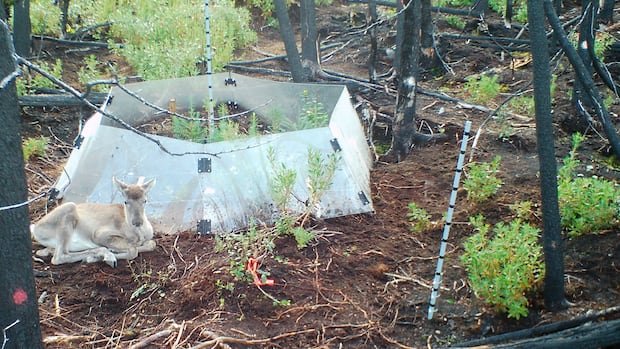

Wildlife in Newfoundland’s forests has been giving a hard time to Lucas Brehaut, a wildfire research scientist, as they keep disrupting his study on forest regrowth after fires. Despite facing challenges like tough terrain and harsh weather, Brehaut and his team have been conducting a study using 19 open-top chambers (OTCs) to monitor seedlings in a warming climate scenario. However, animals like caribou, moose, black bears, wolves, rabbits, and owls have been causing havoc by damaging the equipment, with some even taking off with temperature sensors.
Out of the 19 study sites, 11 have faced disruptions at some point, leading to delays in data collection. Brehaut affectionately refers to one particular problematic site as ‘The Problem Child’ due to recurring damages. Despite the setbacks, Brehaut remains understanding, acknowledging that the animals are simply exploring their habitat, even if it interferes with his research efforts.
Kaitlyn Gaynor, an assistant professor at the University of British Columbia, explains that animals’ curiosity towards new objects is natural behavior, driven by the potential for food sources or perceived threats. Bears, for example, are naturally inquisitive creatures, often investigating new items for possible food. Additionally, human scents left on equipment can attract animals, further complicating research efforts.
Animal interference in research is a global issue, as seen in Gaynor’s experiences in Mozambique, where baboons, hyenas, and especially elephants have caused disruptions. In Brehaut’s case, human interference in the form of snowmobiles accidentally damaging study sites during snowy winters has also posed challenges.
Overall, while animal disruptions can be frustrating for researchers, understanding and adapting to wildlife behavior is crucial to mitigating such issues and ensuring the success of scientific studies in natural environments.