


China has encircled Taiwan with what it terms a “shield of justice” through extensive military exercises involving army, navy, and air force units surrounding the island nation.
These drills, described as menacing, coincide with Beijing’s threat to “annihilate” its smaller neighbor amidst heightened tensions in the region. The significant military demonstration follows the announcement by the US to supply Taiwan with a substantial £8.2 billion arms package.
According to Taiwanese military officials, the large-scale deployment comprises 89 Chinese aircraft, 14 naval vessels, and 14 coast guard ships from China, along with a group of four amphibious assault ships. China vehemently opposed the weapons sale, accusing the US of bolstering its adversaries.
The exercise, named “Justice Mission 2025,” reportedly includes a simulation of blockading the island as part of the maneuvers, establishing what the People’s Liberation Army (PLA) terms a “shield of justice” around Taiwan. The PLA revealed that five blockades currently encircle Taiwan, with the drills scheduled to run until Tuesday to complete Beijing’s “multi-dimensional deterrence” training.
The activities aim to enhance preparedness for maritime and aerial combat patrols, achieving integrated control and securing vital ports and areas, as stated by Shi Yi, a spokesperson for the Eastern Theater Command. The operation serves as a stern caution to forces advocating Taiwan’s independence and external interference, Yi added, emphasizing that any independence endeavors will face annihilation upon encountering the shield.
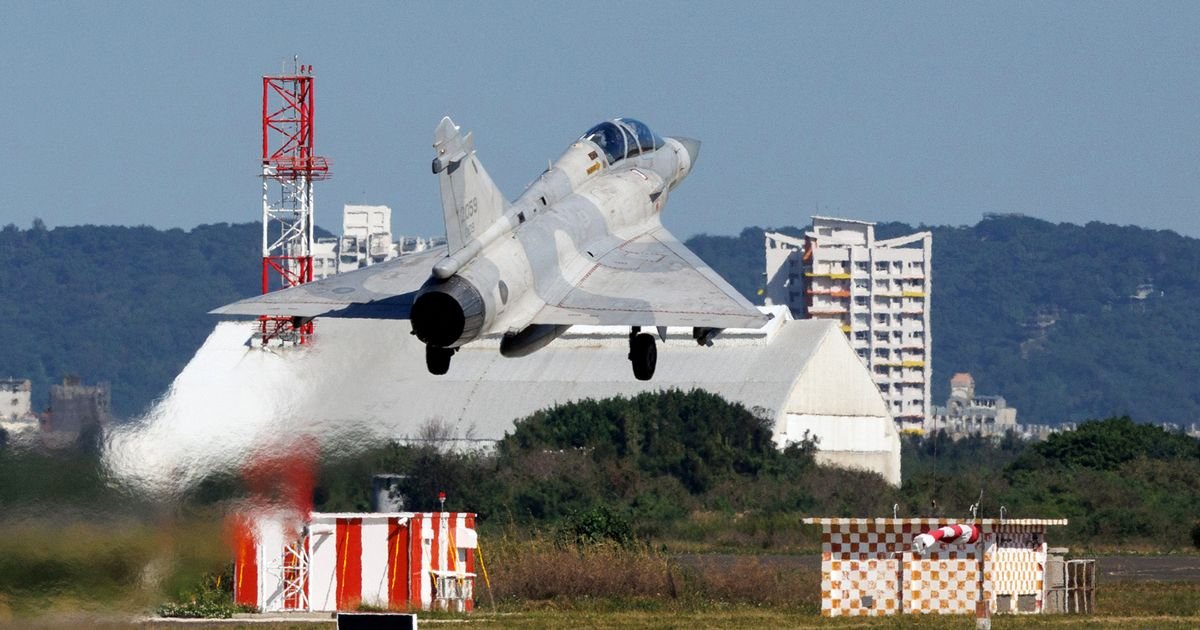
In response to China’s show of force, Taiwan deployed fighter jets to patrol its airspace while its military leadership prepared for exercises simulating a response to a potential invasion. Local reports mentioned Lieutenant General Hsieh Ri-sheng announcing the presence of Chinese naval and coast guard vessels in the Western Pacific, along with an assortment of aircraft and drones monitored within Taiwan’s response zone.
Since assuming office in 2024, Taiwan’s President Lai Ching-te has pledged to increase defense spending amid tensions with Beijing. In October, plans were unveiled for a dome-shaped air defense system to counter perceived threats. However, Beijing has expressed displeasure over Taiwan’s heightened defense expenditures, underscoring the island’s status as a focal point of contention between the US and China.
President Donald Trump has called for Taiwan to allocate approximately 10 percent of its GDP to defense, a move that would represent a substantial funding boost. The Trump administration’s national security strategy urges US allies in the region to contribute more to collective defense efforts, shifting the focus from Europe to the Pacific.
The UK faces pressure to align with the US amid concerns of strategic realignment. The UK’s stance on Taiwan has historically emphasized that the island’s future should be determined by its people, including those in Taiwan. Previous commitments to defend Taiwan from invasion have been reiterated by President Joe Biden, while the new national security strategy seeks to deter aggression through military strength.
Prime Minister Sir Keir Starmer has committed to allocating five percent of GDP to national security by 2035, aligning with Trump’s push for increased NATO defense spending. Defense Secretary John Healey has indicated a planned increase to three percent in the forthcoming parliamentary term, without specifying the exact timeline for achieving this target.